“Is there actually any point in reading to a newborn?”
At first glance, it might seem unnecessary. After all, they can’t sit independently, they barely focus for long, and they certainly don’t understand the storyline.
However, reading to a newborn isn’t about teaching comprehension. Instead, it’s about shaping the brain, strengthening attachment, and laying the foundations for communication long before first words appear.
In fact, those early reading moments matter far more than most parents realise.
Newborns Don’t Understand Words — But They Absorb Rhythm
Although newborns don’t grasp vocabulary, they are incredibly sensitive to sound patterns. From birth, babies are tuned into rhythm, pitch and repetition.
When you read aloud, your baby absorbs:
-
The melody of language
-
The rise and fall of sentences
-
The pacing of speech
-
The emotional tone behind your voice
Because the brain is wired to detect patterns, repeated exposure to rhythmic language begins building early phonemic awareness — the ability to recognise and distinguish speech sounds. Over time, this sound mapping forms the blueprint for later speech.
Therefore, even simple, repetitive books play a powerful role.
Your Voice Regulates Their Nervous System
Beyond language learning, reading to a newborn supports emotional regulation.
For example, when you soften your tone during a bedtime story, your baby’s nervous system responds. Your breathing slows. The environment feels predictable. As a result, your baby associates books with safety and calm.
Consequently, reading becomes more than a literacy activity. It becomes a regulation tool.
Since calm brains are more receptive to learning, this emotional security directly supports cognitive growth.
Eye Contact During Reading Builds Secure Attachment
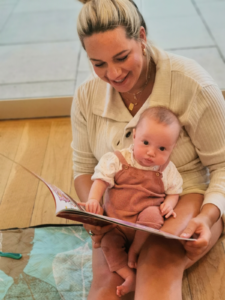
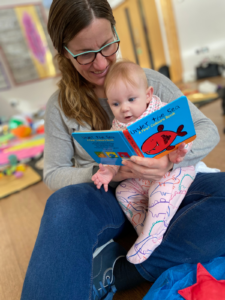
Importantly, reading isn’t just about looking at pages — it’s about shared attention.
During story time, babies often:
-
Glance at the book
-
Look back at your face
-
Pause for your reaction
This back-and-forth exchange is known as “serve and return.” Organisations such as the NSPCC emphasise how these responsive interactions shape brain development and attachment security.
In other words, story time strengthens connection as well as communication.
Secure attachment, in turn, gives babies the confidence to explore language later on.
Repetition Strengthens Neural Pathways
If you find yourself reading the same book night after night, that’s not a problem — it’s powerful.
Each repetition strengthens neural pathways. Because the brain builds through repeated firing of connections, hearing familiar phrases again and again reinforces memory, prediction and attention skills.
For instance, when a baby anticipates a repeated phrase or reacts to a familiar rhythm, they are actively engaging cognitive processes.
Guidance from the NHS encourages talking and reading with babies from birth precisely because these repeated language experiences support speech and communication development.
Joint Attention: A Hidden Superpower
Another crucial developmental milestone supported by reading to a newborn is joint attention.
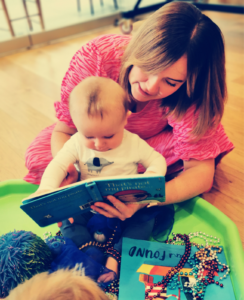
Joint attention happens when your baby focuses on something and then looks to you to share the experience. Although subtle, this skill forms the foundation of later conversation.
Through reading, babies practise:
-
Sharing focus
-
Tracking visual cues
-
Responding to tone
-
Engaging in early turn-taking
As a result, books become tools for social learning.
Why Story Is at the Heart of Adventure Babies
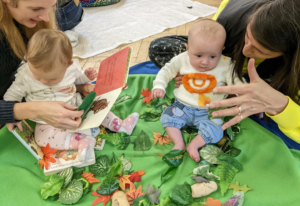
At Adventure Babies, we build everything around immersive storytelling. Rather than simply reading aloud, we layer language with sensory experience.
For example:
-
A “whoooosh” is paired with flowing fabric.
-
A nighttime scene includes soft lights.
-
Repeated phrases are combined with movement or sound effects.
Because sensory input strengthens memory encoding, babies create lasting associations between words and experiences. Consequently, listening skills deepen, attention increases and language pathways strengthen.
We’re not rushing speech. Instead, we’re nurturing the foundations that make speech possible.
What If My Newborn Isn’t Interested?
Firstly, that’s completely normal.
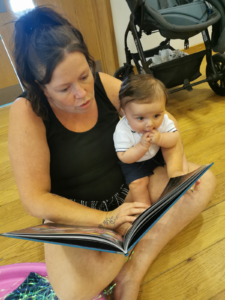
Newborn attention spans are tiny. Sometimes reading lasts two minutes. Sometimes your baby stares at your face instead of the book. Occasionally, they fall asleep halfway through.
Nevertheless, it still counts.
At this stage, the book itself is simply a vehicle. What truly matters is proximity, voice and responsiveness.
FAQs: Reading to a Newborn
When should I start reading to a newborn?
Ideally, from birth. Even in the earliest weeks, babies benefit from rhythmic language exposure.
How often should I read to my newborn?
Short, frequent moments work best. For example, reading once or twice a day for a few minutes is more than enough.
What types of books are best?
High-contrast images, simple repetition and rhythmic text are ideal. However, your tone and engagement matter more than the specific title.
Does reading really help speech development?
Yes. Because reading strengthens phonemic awareness, joint attention, emotional regulation and attachment, it directly supports future speech.
What if my baby looks away?
Looking away often means they’re processing. Therefore, don’t worry — hearing your voice is still beneficial.
The Bottom Line
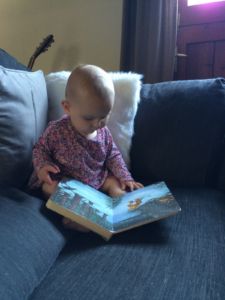
Reading to a newborn is not about early literacy pressure. Rather, it is about connection, regulation and brain development.
Through rhythm, repetition and responsiveness, you are:
-
Supporting emotional regulation
-
Building secure attachment
-
Encouraging joint attention
-
Strengthening language pathways
Ultimately, those early pages are less about the story itself and more about the relationship built around it.
And that relationship? It’s where language truly begins.