“Why don’t I feel like I should?” — The mental health rollercoaster of motherhood
If I had a pound for every time a mum in class whispered, “I thought this was supposed to be joyful… why do I feel so… off?” — I’d be sipping something fancy on a beach instead of chasing after sensory scarves. But here’s the thing: feeling overwhelmed, anxious, sad, or just not quite yourself in those early weeks (or months) is normal. And the sooner we get real about it, the better. Seeking postnatal mental health support for new mums can make all the difference in navigating those feelings.
📊 The not-so-hidden stats
-
Postnatal depression (PND) affects around 10–15% of new mothers in the UK. nhs.uk
- But, those numbers might underplay things — some estimates suggest it could be closer to 1 in 5 when you factor in anxiety, trauma, ongoing depression, and mothers whose babies spent time in neonatal care. england.nhs.uk
- There are also rarer, serious conditions like postpartum psychosis — though less common, they’re very real and need urgent attention. rcpsych.ac.uk
- Even more striking: lots of mums don’t ask for help. Fear of being judged, feeling like a bad mum for struggling, or thinking “this is just how it is” all get in the way. healthiertogether.nhs.uk
I’m going to say it clearly: you are absolutely not alone. Feeling less than glowing doesn’t make you a bad mother. It makes you human. And we don’t talk about that enough.
What it can look like — because it’s not always sadness
Mental health after having a baby isn’t just one thing. For some it’s sadness or crying. For others, it’s anxiety — racing thoughts, fear that something awful will happen to the baby or themselves, or not feeling safe or grounded. Some of us feel guilty for not being “happy,” or angry at ourselves for resenting parts of motherhood. And then there are the intrusive “what if” thoughts — terrifying mental loops that are not the same thing as intent, but feel awful and shameful.
Sometimes there’s a trigger: birth trauma, a difficult breastfeeding journey, sleep deprivation, partner or family conflict, or financial stress. Other times, it just happens. What’s key is that even if you couldn’t predict it, or it looks different from an “ideal” birth story, it’s still legitimate. It’s not your fault.
Why this happens (and why it’s not your fault)
It’s worth remembering that struggling after birth is not a sign of weakness — it’s science. Giving birth is one of the biggest physical and emotional events a body can go through. Your hormone levels (like oestrogen and progesterone) drop sharply in the days after delivery, while oxytocin and prolactin are firing up to support bonding and feeding. Add in sleep deprivation, physical recovery, and the mental shift of suddenly being responsible for a whole new human, and it’s no surprise that moods can swing wildly. These chemical reactions in the body, combined with the sheer scale of life change, mean it’s completely normal to feel unsettled, low, or anxious. There is absolutely no need for judgement — not from yourself, and not from anyone else.
The perception problem
On top of the biology, there’s also the huge weight of expectation. We’re constantly told that having a baby is a wholly positive experience, that we should feel lucky to be on maternity leave, and grateful for every sleepless night because “these days are precious.” At the same time, there’s the unspoken assumption that our careers or sense of self should take a backseat without complaint. When that’s the narrative surrounding motherhood, it can make it so much harder to admit when we’re struggling. If you don’t feel constantly glowing with gratitude, you might feel like you’re failing — when in reality, you’re just experiencing the truth of what it means to be human in an enormous life shift.
What helps — small things that can make a big difference
I wish there was a magic wand. But most of what helps is about connection, permission, and kindness to yourself.
| What helps | Why it matters |
|---|---|
| Talking it out (with a friend, partner, peer, or therapist) | Sharing your feelings helps you realise they’re not unique, and the shame or fear often lessens. |
| Peer support or mum groups (in person or online) | Hearing “me too” is powerful — it normalises what you’re going through. |
| Self-care, when possible | This might look laughably small — getting a hot drink while it’s still warm, going for a short walk with baby, or even five minutes of breathing. These moments add up. |
| Sleep — or rest — whenever possible | Resting, even if not sleeping, can sometimes help break the anxiety cycle. |
| Professional help when the overwhelm is too much | Whether talking therapies or medication, professional help is a vital form of postnatal mental health support for new mums. You deserve it just as much as your baby deserves care and attention.
|
Pro tip: If you think something feels off, it’s worth saying to your GP: “I think I’m struggling with postnatal depression or anxiety.” Saying the words out loud can change the outcome.
My (Unfinished) Story
When I became a mum, I was so sure I’d feel magical all the time. Instead, I remember dark evenings when all I wanted was someone to tell me it was okay to not feel okay.
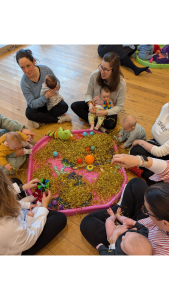
It wasn’t until I spoke to another mum in playgroup—one who said, “Actually, I cry in the stairwell when the baby finally sleeps, and I don’t even know why”— that I realised I wasn’t alone. We sat on the floor with babies snoozing in their slings, and cried a bit, and laughed a bit, and shared tips. And that was transformative.

When to reach out — red flags to watch out for
If any of the following are happening, it’s time to reach out:
-
Low mood or anxiety that isn’t easing up.
-
Intrusive thoughts that scare you.
-
Feeling hopeless, disconnected, or like you can’t cope.
-
Struggling to care for yourself or your baby.
-
Symptoms of postpartum psychosis (hallucinations, delusions, extreme mood swings).
If you’re ever unsure, it’s better to reach out than to wait. Ask your GP, midwife, or health visitor for a perinatal mental health referral.
Final thoughts
Motherhood is often sold to us as a fairy tale, but what we’re getting is more like an emotion-packed gladiator arena. Sometimes you fall down. Sometimes you cry. Sometimes you think, “what on earth was I thinking?” But that doesn’t mean you failed. It means you’re human.
Here’s the radical truth: needing help doesn’t mean you’re weak. Reaching out for postnatal mental health support for new mums could be the first step toward feeling like you again.