
Newborn Daily Routine: How to Create Calm Structure in the First Months (Without the Pressure)
The early weeks with a baby can feel beautifully chaotic.
One minute you’re staring at their tiny fingers in awe.
The next, you’re wondering if you’ll ever drink a hot cup of tea again.
If you’ve been searching for a newborn daily routine, what you’re probably craving isn’t control.
It’s steadiness.
A rhythm that makes the days feel less overwhelming — and more manageable.
The good news? A newborn routine doesn’t need to be rigid to support your baby’s development. In fact, the most effective routines in the first year are flexible, responsive and built around connection.

What Does a Healthy Newborn Daily Routine Actually Look Like?
Newborns aren’t biologically wired for strict schedules. Their sleep cycles are short. Their feeding patterns are irregular. Their nervous systems are still developing.
Instead of clock-based scheduling, think in patterns:
Feed → Change → Interaction → Sleep
That simple cycle forms the backbone of many newborn daily routines.
Over time, repetition helps your baby:
-
Anticipate what comes next
-
Feel emotionally secure
-
Regulate stress
-
Develop early memory pathways
Predictability is calming for the developing brain. Research consistently shows that responsive, consistent caregiving supports secure attachment and emotional resilience later on.
Routine isn’t about perfection.
It’s about safety through repetition.

Nappy Changes: Repetition That Builds Communication
In the early weeks, you may change your newborn’s nappy 8–12 times per day.
It feels relentless — but it’s also a powerful developmental opportunity.
During nappy changes your baby is:
-
Watching your facial expressions
-
Listening to your tone of voice
-
Experiencing gentle touch
-
Learning predictable sequences
These repeated interactions support early language pathways and attachment.
If soreness appears, the NHS advises frequent changes, gentle cleaning and barrier cream use to prevent and treat nappy rash. (Search “NHS nappy rash” for full UK guidance.) Allowing short periods of nappy-free time can also help skin recovery — and gives babies space to stretch and kick, strengthening hips and core muscles.
Even routine care supports physical development.
Baby Gear & Development: What Really Matters?
Choosing baby gear can feel overwhelming — especially in the UK market where options are endless.
When building a newborn daily routine, the right equipment should support comfort, safety and development.
Baby Carriers
Proper positioning is crucial. The International Hip Dysplasia Institute recommends carriers that support the “M-shaped” leg position to protect developing hip joints.
But beyond hip health, babywearing supports:
-
Emotional regulation
-
Reduced crying
-
Bonding and attachment
-
Vestibular development (through gentle movement)
Babies worn close often settle more easily, which naturally supports daily rhythm.
Pushchairs & Sleep Support
Newborns require full head and neck support. Without developed neck strength, unsupported positioning can cause strain.
The NHS baby sleep guidance also reminds parents that frequent waking in the early months is normal. A newborn daily routine should adapt to this reality — not fight it.
Structure supports development. But flexibility supports sanity.
Why Rhythm Supports Brain Development
In the first year, your baby’s brain is building over one million neural connections per second.
Repetition strengthens those connections.
When your baby experiences predictable cycles — feeding, changing, interaction, rest — their nervous system begins to regulate more effectively.
This supports:
Emotional Development
Predictable care reduces cortisol (stress hormone) levels.
Cognitive Development
Repeated experiences help babies recognise patterns and anticipate outcomes.
Physical Development
Regular tummy time, stretching and movement build core strength and coordination.
Social Development
Familiar weekly experiences introduce manageable social exposure.
This is one reason why gentle sensory storytelling sessions can be such a powerful addition to a newborn daily routine.
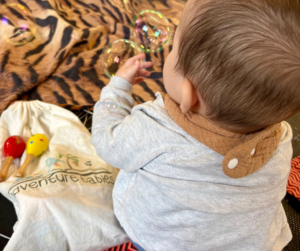
In our Adventure Babies classes, babies experience consistent sensory sequences — light, sound, texture and story — while remaining anchored to their caregiver. Over weeks, we see:
-
Faster settling
-
Increased eye contact
-
More confident reaching and movement
-
Greater environmental curiosity
That’s routine supporting development in action.

Building a Newborn Daily Routine Without Pressure
If your days still feel unpredictable, that doesn’t mean you’re doing it wrong.
A newborn routine emerges gradually.
Start small:
-
A consistent wind-down song before naps
-
A short tummy time after morning feed
-
A regular weekly class
-
Talking through each nappy change
Tiny repeated anchors create rhythm.
Rhythm creates security.
Security builds confidence — in babies and in parents.
FAQ: Newborn Daily Routine (UK Parents)
When should I start a newborn daily routine?
From birth, focus on responsive care rather than strict scheduling. Patterns usually begin to emerge naturally by 6–8 weeks.
How many naps should a newborn have?
Newborns may sleep 14–17 hours in 24 hours, often in short stretches. Frequent waking is normal according to NHS guidance.
How often should I change my newborn’s nappy?
Typically 8–12 times per day in the early weeks. Always change promptly after bowel movements to prevent nappy rash.
Does babywearing help with routine?
Yes. Babywearing can support emotional regulation, reduce crying and make daily rhythms smoother by keeping your baby calm and close.
Do baby classes help establish routine?
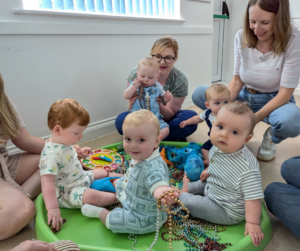
A weekly class provides a predictable anchor in your routine. Repeated sensory experiences in a secure environment support cognitive, social and emotional development — while also offering reassurance for parents navigating early months.

Final Thoughts
If you searched for “newborn daily routine” hoping for the perfect schedule, here’s something gentler:
Your baby doesn’t need perfection.
They need repetition.
Responsiveness.
And a caregiver who keeps showing up.
Structure will come.
Confidence will come.
And often, it grows quietly — in the everyday moments you’re already living.