
How to Stimulate Your Baby Without Overstimulating Them
(Finding the balance in those early, fragile months)
Some days your baby seems perfectly content just watching the light move across the wall. Other days, they’re wide-eyed, wriggly and fighting sleep by mid-morning — and you’re left wondering what changed.
In those early months, it’s not always obvious whether your baby needs more stimulation, or whether the world has already given them plenty. Learning to spot the difference takes time — and a lot of reassurance.
And yet, there’s a quiet pressure in modern parenting to always be doing something. Talking. Singing. Playing. Going places. Making the most of every wake window.
So how do you support your baby’s development without tipping them into overwhelm?
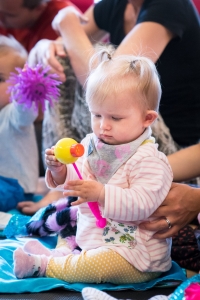
First things first: stimulation isn’t about doing more
Stimulating your baby doesn’t mean filling their day with activities, toys or noise.
In the first year of life, stimulation is about experience, not entertainment.
It’s about:
-
Seeing a new colour
-
Feeling a different texture
-
Hearing a familiar voice in a new rhythm
-
Moving their body in a way that feels safe
These moments don’t need to be big or busy to be powerful. In fact, babies learn best when experiences are simple, repeated and emotionally safe.
Guidance on baby development in the first year, including how babies respond to sensory experiences, shows that simple, repeated interactions are far more beneficial than constant novelty.
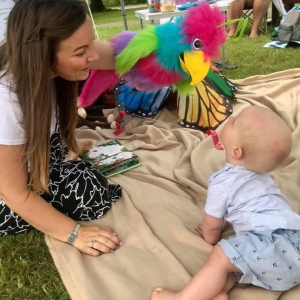
How can you tell if your baby is getting the right amount?
A baby who is comfortably stimulated might:
-
Watch your face closely
-
Kick, reach or wriggle with curiosity
-
Babble or coo during play
-
Settle fairly easily afterwards
When things tip into overstimulation, it often looks like:
-
Turning their head away
-
Becoming suddenly fussy or tearful
-
Arching their back
-
Struggling to settle or sleep
If that sounds familiar, it isn’t a sign you’ve done something wrong. It usually just means your baby’s brain has had enough input for now.
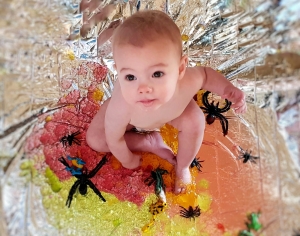
Why “less, but better” works so well for babies
Babies don’t process the world the way adults do.
What feels gentle to us — music playing, toys flashing, people chatting — can be a lot for a developing nervous system. That’s why stimulation works best when it’s intentional and layered carefully.
A calm voice paired with gentle movement.
A new texture explored slowly.
A story repeated week after week until it feels familiar.
This is how babies build:
-
Focus and attention
-
Emotional regulation
-
Curiosity without stress
-
Confidence to explore
And it’s why predictable, well-balanced sensory experiences are so valuable in the first year.
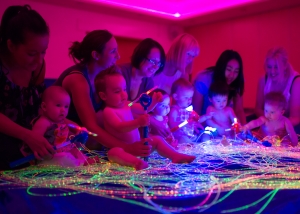
You don’t have to create it all yourself
One of the hardest parts of early parenthood is constantly wondering if you’re doing enough — or too much.
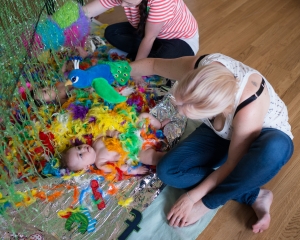
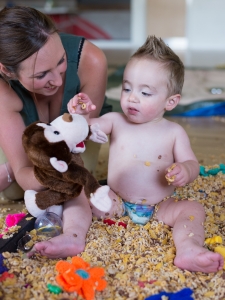
This is where thoughtfully designed sensory experiences — like those offered in Adventure Babies sensory storytelling classes — can be incredibly supportive for both babies and parents.
There’s no pressure for babies to “perform” or engage in a certain way. Some weeks they watch quietly. Some weeks they dive right in. Both are exactly right.
And for parents, there’s a huge comfort in knowing the stimulation is already thoughtfully planned — you can simply enjoy being there with your baby.
The quiet benefits parents don’t always expect
Joining a baby class often brings more than you think it will.
It can mean:
-
Feeling reassured that your baby is developing normally
-
Picking up ideas you’d never have thought of at home
-
Getting out of the house without having to entertain
-
Sitting alongside other parents who are figuring it out too
Sometimes the biggest relief is realising that babies don’t need constant input — and neither do parents.
A gentle reminder
Your baby doesn’t need a packed schedule.
They don’t need constant stimulation.
And they certainly don’t need perfection.
What they need is space to explore, familiar rhythms, and someone who notices when they’ve had enough.
If you’d like to experience sensory play that’s carefully balanced, developmentally supportive and wrapped up in beautiful storytelling, you can find your local Adventure Babies class here.
And if nothing else, you’ll leave knowing you’re doing just fine.