How to Help My Baby Talk: What Really Builds Speech in the First Year
There’s a moment most parents have.
You’re sitting on the floor. Your baby is making a string of mysterious noises. And you suddenly think:
Should they be saying more by now?
Am I doing enough?
How do I actually help my baby talk?
First things first — if you’ve asked that question, you’re already doing one of the most important things.
You care.
Let’s gently unpack what really builds speech in the first year — and why it starts long before first words.
Speech Starts Before Words
When parents search “how to help my baby talk,” they’re often imagining first words.
“Mama.”
“Dada.”
“Dog.”
But baby speech development begins months before that.
It begins with:
-
Eye contact
-
Cooing
-
Back-and-forth sounds
-
Facial expressions
-
Shared attention
Long before your baby says a word, they are wiring their brain for communication.
Speech isn’t a milestone that suddenly appears.
It’s built in tiny, repeated moments.
The Real Secret to Helping Your Baby Talk
It isn’t flashcards.
It isn’t apps.
It isn’t pressure.
It’s connection.
Language develops through something called “serve and return” interaction (don’t worry — no jargon test here).
Your baby makes a sound.
You respond.
They respond again.
That back-and-forth is the foundation of communication.
When you narrate a nappy change…
When you copy their babble…
When you pause to let them “answer”…
You are literally strengthening neural pathways.
This is why predictable routines matter too. In our post on building a newborn daily routine, we talk about how repetition builds security — and security creates the emotional safety needed for communication to flourish.
Babies talk more when they feel safe enough to try.
Reading Is Not About the Story (Yet)
If you’ve ever tried reading to a 4-month-old who is attempting to eat the book, you might wonder whether it counts.
It does.
Reading to a baby supports:
-
Listening skills
-
Sound pattern recognition
-
Emotional regulation
-
Joint attention
-
Vocabulary exposure
They don’t understand the plot. But they understand rhythm. Tone. Facial expression.
And most importantly — they understand that this is shared.
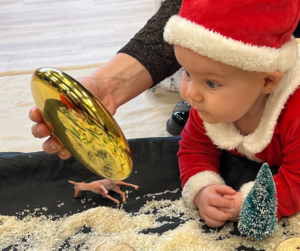
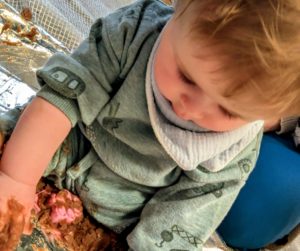
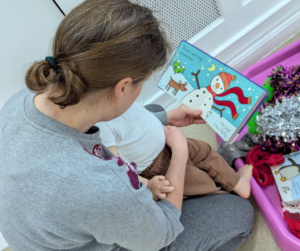
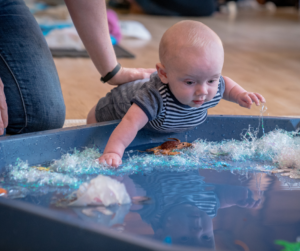
At Adventure Babies, our sensory storytelling sessions are built around this exact principle. When babies experience story through light, sound and texture — while sitting securely with their grown-up — they are linking language with positive emotional memory.
That link matters.
Emotion strengthens memory.
Memory strengthens language pathways.
When Do Babies Start Talking?
Most babies say their first word around 12 months.
But before that you might notice:
-
Cooing (6–8 weeks)
-
Babbling (4–6 months)
-
Repetitive sounds like “bababa” (6–9 months)
-
Gestures like pointing and waving
Receptive language (what they understand) develops before expressive language (what they say).
So if your baby turns when you say their name, recognises familiar words, or looks at an object when you label it — they are already building speech foundations.
Communication starts with understanding.
The Things That Matter Most
If you want a simple checklist for how to help your baby talk, here it is:
✔ Talk more than you think you need to
✔ Slow down and pause
✔ Get face-to-face
✔ Follow their interests
✔ Read daily (even briefly)
✔ Respond to their sounds
✔ Repeat words often
You don’t need to perform.
You need to interact.
A Gentle Reality Check
Social media can make baby development feel competitive.
But speech and language development isn’t a race.
It’s relational.
Some babies talk early. Some later. What matters most in the first year is that they are exposed to rich language in a responsive, emotionally safe environment.
And sometimes, being in a room with other parents and babies helps more than you realise.
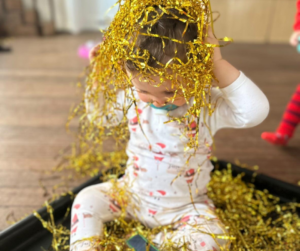
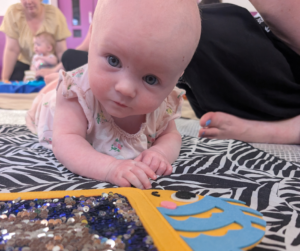
In our classes, we often see babies who are quieter at first begin to vocalise more over time — not because they’re “pushed,” but because they’re immersed in a language-rich, sensory environment that feels secure.
Communication grows where connection lives.
If You’re Worried
If your baby:
-
Isn’t responding to sounds
-
Doesn’t make eye contact
-
Isn’t babbling by around 9 months
-
Or you feel something isn’t quite right
Trust your instinct and speak to your GP or health visitor. Early support is always positive.
But if your baby is babbling, watching, listening, gesturing and engaging — even if words haven’t arrived yet — they are building exactly what they need.
Final Thoughts
If you’re wondering how to help your baby talk, the answer isn’t more pressure.
It’s more presence.
Talk to them.
Read to them.
Pause for them.
Watch them.
And remember — speech is built in the ordinary, everyday moments you’re already living.
And that’s something you’re doing beautifully.
Read our thoughts on separation anxiety here