Can Babies Learn New Words From Books Before They Can Speak?
Your baby cannot say “duck” yet, but the moment you open their favourite book, their eyes flick towards the little yellow bird. Coincidence? Perhaps. But they may already recognise more than they can tell you.
If you have wondered how do babies learn words from books, the answer starts long before a clear first word. Sharing a book gives your baby chances to connect the sounds you make with the pictures they see, the things they touch and the moments you enjoy together.
That does not mean every story teaches a new word immediately. Instead, familiar books offer repeated, gentle opportunities to build understanding — with you as their favourite reading companion.
Understanding comes before talking
Imagine knowing what you want to say but not yet having the coordination to say it. Babies face something rather like that: understanding a word and producing it involve different skills.
Researchers studying babies aged six to nine months found that, as a group, they looked towards pictures of familiar foods and body parts when a parent named them. Those small shifts in attention revealed understanding without a spoken answer.
The study on early word understanding did not test whether books had taught those words. However, it shows why we should not assume that a baby who cannot talk has nothing to gain from hearing us name a picture.
Your baby’s first spoken word is an exciting milestone. The learning that supports it starts much more quietly.
How do babies learn words from books?
Think about a page showing a dog. Your baby looks at the picture, you point and say “dog”, then add a cheerful “woof!”
Across many encounters, your baby has opportunities to connect that sound with that animal. A clear picture helps narrow down what you might mean, while your pointing and attention offer extra clues.
Everyday conversation can feel like a fast-moving stream of sounds. A book lets you slow things down. The dog stays on the page while you name it, pause and notice your baby’s reaction.
Later, a dog appears on a walk. “Look, a dog! Like the dog in your book.” Now the same word has another useful connection.
A picture of a ball is not actually a ball
Here is an easily overlooked achievement: learning from a book means making sense of a flat picture that represents something in the real world.
Adults make that connection automatically. Babies and toddlers have to develop it.
In research on toddlers’ understanding of pictures, researchers taught children a new word during a picture-book activity. Many children, including some aged 15 months, then applied that word to the real object.
That is much more than remembering a sound on a page. It suggests an emerging understanding that a picture can stand for something beyond the book.
You can offer similar connections at home. Point to a pictured ball, then roll a real one together. Say “ball” naturally in both moments, without expecting your child to repeat it.
Your baby does not need to follow the plot
A newborn cannot understand why the bear has lost his hat. Even so, sharing the story gives them time to hear your voice and experience its changing rhythm.
As babies grow, pictures, repeated phrases and familiar sounds offer more to explore. An older baby might notice the cat on every page while completely ignoring the main character.
Follow that interest. “There’s the cat again. The cat’s sleeping.”
Reading every printed word is optional. Looking at one picture and chatting about it still counts as sharing a book. You can enjoy a story together without reaching the ending — or even leaving the first page.
The conversation around the book matters
You may start with the printed sentence, then find yourself talking about something else entirely.
“The baby’s wearing socks. You’ve got socks too!”
Those little additions connect the book with your child’s own world. When you notice what holds their attention, your words have a clear focus.
Try making a comment, then leaving a comfortable pause. A glance, movement, babble or point gives you something to respond to, even before your baby can answer with words.
Speech and Language UK’s advice on sharing books encourages parents to follow their child’s interests and avoid too many testing questions. You can replace another “What’s that?” with “A duck! It’s swimming.”
Storytime feels warmer when nobody has to pass a quiz.
Why the same book earns its place on repeat
By the fifth reading, you may feel ready for a new storyline. Your baby may still have plenty to discover in this one.
Familiar pages give them more chances to hear the same words alongside the same pictures. Knowing what comes next can also make joining in easier.
Perhaps your toddler starts making the animal sound before you do. Another day, they point to the right picture as you turn the page.
Enjoy those moments without turning each reading into a check. Repetition offers opportunities; it does not create a deadline for saying a word.
Keep favourite books within reach, alongside a few others you can explore when the mood takes you.
What might this look like from birth to two?
During the early months, keep things simple: hold your baby comfortably, show a clear picture and talk in your usual warm voice. A brief look together is enough.
As their interest grows, name whatever catches their eye. Faces, animals and familiar everyday objects give you plenty to chat about. Let your baby set the pace.
Through the second year, try adding a little more to what your toddler communicates. If they point at a car, say “A car. A red car!” If they say “dog”, you might reply, “Yes, the dog’s running.”
These are flexible ideas, rather than age-based tests. Choose books and conversations that suit your child’s interests and communication.
Bring a little of the story into play
A book about rain can lead to watching raindrops at the window. A story featuring a rabbit might inspire a game with a rabbit puppet.
Use the words again as you play: “The rabbit’s hiding. Where has it gone?”
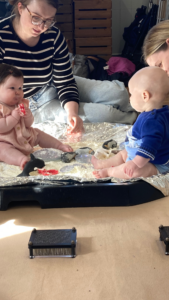
At Adventure Babies sensory storytelling classes, we bring stories to life through books, puppets, songs and sensory experiences. Children can hear a word within a story, then explore a related prop or action with their grown-up.
That gives families more ways to enjoy and revisit the story together. You can also browse our books and sensory storytelling resources for inspiration at home.

A small moment can be enough
Some days, your baby will settle for a whole story. On others, they will turn three pages at once and head off to investigate the room.
Neither experience tells you how much language they understand. Offer another relaxed opportunity later, without pressure to finish or perform.
If you have concerns about your child’s hearing, understanding or communication, speak to your health visitor. Seek advice promptly if they lose skills they previously had.
Meanwhile, keep enjoying the little exchanges: a picture, a familiar word, a shared smile. Your baby does not need to speak for you to have something to talk about.