The Real Reason Babies Love Lift-the-Flap Books
Why Interactive Books for Babies Feel Like Pure Witchcraft
There are few things in life more humbling than spending £8 on a beautifully written baby book only for your child to become emotionally obsessed with a cardboard flap containing a drawing of a sheep.
Not the story.
Not the words.
Just the flap.
And somehow, despite having seen the sheep approximately 947 times already that day, your baby still reacts like it’s the greatest plot twist in literary history.
Pure joy. Shock. Screaming. Kicking legs. Full-body excitement.
Meanwhile you’re there doing the world’s least appreciated theatre performance:
“WHERE could the sheep POSSIBLY be???”
Again.
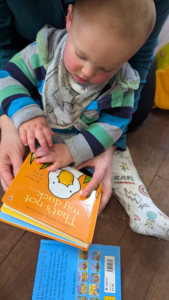
At Adventure Babies we see this all the time in classes. Babies absolutely lose their minds over lift-the-flap books, peekaboo games and repeated surprises — and honestly, there’s a really fascinating developmental reason behind it.
Because interactive books for babies are doing far more than keeping them entertained for six minutes while you drink lukewarm tea.
Why Babies Love Interactive Books So Much
Babies are basically tiny scientists.
Everything is an experiment. Every interaction is your baby trying to work out:
- what happens next
- whether things disappear permanently
- how cause and effect works
- whether the world feels predictable and safe
That’s why the best interactive books for babies often involve flaps, sliding parts, textures or repeated surprises. They help babies practise one of the biggest concepts in early development: anticipation.
And honestly? Babies are absolutely addicted to anticipation.
You can see it happen in real time. The second your baby recognises a familiar flap book, they start wriggling with excitement before you’ve even opened it properly. Their brain already knows what’s coming.
That moment matters more than most people realise.
The Hidden Brain Development Happening During Lift-the-Flap Books
One of the most important developmental skills babies learn in the first year is something called object permanence.
This is the understanding that something still exists even when they can’t currently see it.
Which sounds obvious to adults, but for babies it’s genuinely mind-blowing.
Before babies develop object permanence, things literally feel like they vanish from existence when hidden. This is why very young babies can act shocked every single time you reappear during peekaboo, even though you’ve been doing it for months and are frankly running out of enthusiasm for the performance.
According to Zero to Three, games involving hiding and revealing objects help babies build memory, prediction skills and understanding of the world around them.
Lift-the-flap books are basically peekaboo in book form.
Your baby lifts the flap…
something appears…
their brain releases a tiny burst of excitement…
and suddenly they want to do it another 400 times.
Which explains why parents of babies spend huge portions of their lives dramatically revealing cartoon animals hidden under cardboard squares.
Why Babies Love Repetition (Even When Parents Want to Hide the Book)
One of the biggest parenting shocks is realising babies don’t get bored anywhere near as quickly as adults do.
Adults crave novelty.
Babies crave familiarity.
That same flap reveal that makes you question your sanity by bedtime? Your baby experiences it differently every single time. Repetition helps babies strengthen neural pathways and build confidence through predictability.
This is why babies:
- demand the same books repeatedly
- laugh at the same reveal every time
- become obsessed with one particular page
- kick excitedly before the flap even opens
At Adventure Babies classes, we often reassure parents that repetition is not a sign your baby needs “more stimulation.” It usually means the exact opposite — they are deeply engaged in learning.
And honestly, there’s something quite lovely about that once you stop fighting it.
The Sensory Magic of Interactive Books for Babies
The best interactive books for babies don’t just teach literacy. They engage multiple senses at once.
Babies are:
- touching flaps
- tracking movement visually
- listening to your voice
- anticipating outcomes
- practising fine motor skills
- learning emotional responses through shared reactions
That combination is incredibly powerful for brain development in the first year.
Research from Harvard University’s Center on the Developing Child highlights how repeated responsive interactions help build strong neural connections in infancy. Shared reading moments become especially valuable because babies are learning through both the activity itself and the emotional connection attached to it.
Which means your dramatic “OOOH LOOK A BUNNY!” voice actually serves a developmental purpose after all.
Vindication.
Why Lift-the-Flap Books Feel So Emotional Sometimes
This is the bit people don’t really talk about enough.
Interactive books create connection.
Not in some lofty Pinterest-parenting way. In a real-life, sitting-on-the-floor-in-yesterday’s-leggings kind of way.
Your baby looks at you before the flap opens.
You pause dramatically.
They squeal before the reveal.
You both laugh.
That back-and-forth interaction is relationship-building. Your baby is learning:
- communication
- turn-taking
- emotional connection
- shared attention
- trust and predictability
And honestly? For exhausted mums, those tiny moments of shared joy matter too.
Because when you’ve spent all day changing nappies, cutting toast into tiny pieces and wondering if you’ll ever sit down again, having your baby absolutely lose their mind over a flap book can weirdly become the highlight of your day.
The Best Interactive Books for Babies (That Parents Won’t Hate Reading)
Some genuinely brilliant interactive books we see babies adore again and again include:
- Dear Zoo by Rod Campbell
- Where’s Spot? by Eric Hill
- That’s Not My… series by Fiona Watt
- Peekaboo books by Camilla Reid
- sensory touch-and-feel books with textures and mirrors
The magic is rarely about complicated stories. Babies tend to love:
- predictable repetition
- bold pictures
- simple surprises
- interactive elements
- familiar routines
And honestly, the best book is usually the one your baby wants to read repeatedly while bouncing aggressively on your lap.
Why These Tiny Moments Matter So Much
Sometimes parenting advice makes everything sound huge and high pressure.
Optimise tummy time.
Maximise development.
Stimulate constantly.
Create enriching experiences.
Meanwhile your baby is having the time of their life opening the same flap containing the same cow for the seventeenth consecutive time.
And maybe there’s something reassuring in that.
Because the magic of early childhood is often incredibly simple.
A familiar book.
A silly voice.
A repeated surprise.
A baby who feels safe enough to laugh before they even know what’s underneath the flap.
At Adventure Babies Classes we believe stories become magical when babies experience them with their whole bodies — through sensory play, connection, repetition and joy.
And honestly? Lift-the-flap books might be one of the best examples of that there is.