
From Wobbly to Walking: Baby Physical Development in the First Year (And What Really Matters)
If you’ve ever found yourself Googling “when should my baby roll?” or quietly wondering why another baby the same age is already sitting, crawling, or even standing…
You’re not alone.
Baby Physical development in the first year can feel like a bit of a moving target. One minute your baby is lying still, the next they’re rolling across the room, and suddenly you’re wondering how you got here so quickly.
It’s incredible—but it can also bring a quiet pressure.
Am I doing enough?
Should they be doing more?
Am I missing something?
So let’s take a breath and reframe it.
Because baby physical development isn’t a race—it’s a process. And understanding what’s happening underneath it all can make everything feel a lot calmer (and a lot more fascinating).
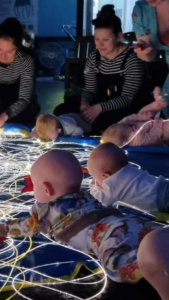
What’s Really Driving Baby Physical Development?
When we think about physical milestones—rolling, sitting, crawling, walking—it’s easy to focus on the outcomes.
But what really matters is everything happening underneath.
Your baby isn’t just learning to move.
They’re building a complex connection between their brain and body. Every kick, stretch, reach, and wobble is part of a much bigger picture—one where the brain is learning how to control movement, balance, coordination, and strength.
According to guidance from the NHS, babies develop physical skills through opportunity, interaction, and exploration—not pressure.
And that’s where things start to feel a bit more reassuring.
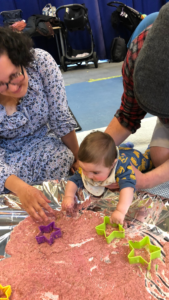
The Hidden Systems Behind Movement (That No One Talks About)
Before your baby can sit, crawl, or walk, their body is quietly developing two incredibly important systems.
The first is the vestibular system—this is what helps your baby understand balance and movement. It’s why they enjoy being gently rocked, lifted, or moved through space. Every time they experience motion, their brain is learning how their body relates to gravity.
The second is the proprioceptive system, which helps your baby understand where their body is and how it moves. It’s what allows them to coordinate their arms and legs, to reach for a toy, or eventually take those first steps.
These systems don’t develop through instruction.
They develop through movement.
Through being held, rolled, lifted, allowed to wriggle and explore.
Through experience.
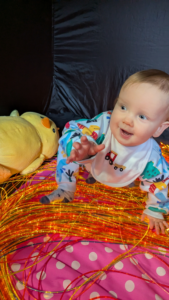
Those Early Reflexes? They Matter More Than You Think
In the early weeks, many of your baby’s movements are actually reflexes.
The startle reflex when they fling their arms out suddenly.
The way they grip your finger tightly.
The stepping motion when their feet touch a surface.
These are known as primitive reflexes, and they’re built into your baby’s nervous system from birth.
Over time, as your baby’s brain matures, these reflexes begin to integrate (or fade), making way for more controlled, intentional movement.
This process is a crucial part of development.
It’s how your baby moves from automatic reactions to purposeful actions—reaching, rolling, sitting, and eventually walking.
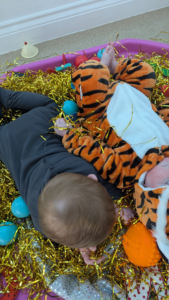
Why Core Strength Is the Foundation for Everything
Before your baby can sit independently or take their first steps, something else has to happen first.
They need strength.
Not in the way we think about it as adults—but deep, foundational strength in their core muscles.
Every time your baby spends time on the floor, lifts their head, pushes up, or shifts their weight, they’re building the strength they need for the next stage.
This is why development follows a natural progression.
Head control comes before sitting.
Sitting before crawling.
Crawling before walking.
It’s not random.
It’s a carefully built sequence where each stage supports the next.
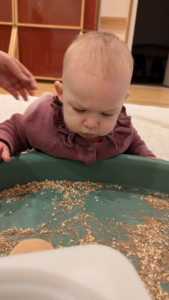
Why Floor Time Matters More Than You Might Think
It’s very easy in modern life to rely on containers—car seats, bouncers, swings, seats that keep babies upright.
And while these can be helpful in small doses, they don’t offer what your baby really needs for physical development.
Your baby needs space.
Space to stretch.
To roll.
To push, pull, and pivot.
To try, fail, and try again.
Floor time gives your baby the freedom to explore movement in their own way, at their own pace.
It allows their brain and body to work together, figuring things out through experience rather than being placed into positions they’re not quite ready for.
And that’s where real development happens.
The Brain-Body Connection: How Movement Builds Learning
Every time your baby moves, something important is happening in their brain.
Movement isn’t just physical—it’s neurological.
When your baby reaches for a toy, their brain is coordinating vision, intention, and muscle control. When they roll, they’re learning about spatial awareness. When they crawl, both sides of the brain are working together in a coordinated way.
This is why movement plays such a big role in overall development—not just physically, but cognitively too.
It supports:
- coordination
- problem-solving
- confidence
- independence
Your baby isn’t just learning to move.
They’re learning how to learn.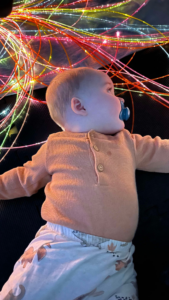
So… What Should You Be Doing?
This is often where parents expect a list of exercises or structured activities.
But just like with brain development, the answer is much simpler.
Your baby needs opportunity, not pressure.
They need:
- time on the floor
- freedom to move
- encouragement, not intervention
- space to explore at their own pace
You don’t need to rush them into sitting.
You don’t need to “teach” them to walk.
Their body knows what to do.
Your role is to give them the environment to do it.
How Adventure Babies Supports Physical Development
At Adventure Babies, movement is woven naturally into everything we do.
Our sensory storytelling sessions aren’t just about engagement—they’re designed to support both fine and gross motor development in a way that feels playful and pressure-free.
Through reaching, grasping, exploring textures, moving to music, and interacting with their environment, babies are given the opportunity to:
- build strength
- develop coordination
- explore movement safely
- connect brain and body
All while you’re right there with them.
No pressure. No expectations. Just development happening as it should.
👉 Find your nearest Adventure Babies class
👉 Explore more baby development support on our blog
A Final Reassurance (Because Comparison Creeps In)
It’s very easy to look at other babies and wonder where yours “should” be.
But the truth is, there is a wide range of normal.
Some babies roll early. Some take their time.
Some crawl. Some shuffle. Some go straight to walking.
And all of it can be completely okay.
Because physical development isn’t about hitting milestones first.
It’s about building the strength, coordination, and confidence your baby needs in their own time.
So if you’re watching your baby wobble, stretch, roll, or simply lie there taking it all in…
Know that something important is happening.
They’re learning.
They’re building.
And they’re exactly where they need to be 💛
Frequently Asked Questions
When should my baby start rolling, sitting, or walking?
There’s a wide range of normal. Most babies roll between 3–6 months, sit around 6 months, and walk between 9–18 months—but variation is completely natural.
Is tummy time really important?
Yes—tummy time helps build the strength babies need for rolling, sitting, and crawling.
Do babies need to crawl before walking?
Not always. While crawling is beneficial, some babies skip it and still develop normally.
Are baby walkers or seats helpful?
They can limit natural movement if overused. Floor time is far more beneficial for development.
How can I support my baby’s physical development at home?
Give them space to move, avoid too much time in containers, and allow them to explore at their own pace.