Drop It. Watch It. Repeat: Why Letting Go Is a Big Little Skill
Your baby holds out a toy. You offer your hand.
For one lovely moment, you think they’re giving it to you.
Their fingers tighten. A brief tug of war follows. Seconds later, they drop it somewhere completely different.
If you’ve noticed your baby learning to release objects, you might wonder why letting go seems so complicated. Surely opening a hand should be easier than grabbing something?
Actually, releasing an object on purpose takes control. Choosing where to put it adds another challenge.
That toy landing beside the basket rather than inside it? There’s more happening than you might think.

Why letting go takes practice
Think about putting your phone on a table. Your arm moves towards the surface, your hand steadies it and your fingers release at the right moment.
You barely notice the sequence.
For your baby, those actions still need practice. Holding something, moving it towards a target and opening their fingers are separate parts of the job.
West Suffolk NHS Foundation Trust’s guidance on fine motor skills explains that releasing an object deliberately requires control over both timing and placement.
An object slipping from a young baby’s hand differs from an older baby deliberately dropping it into a container. The result may look similar, but the intention and control can differ.
Holding it out doesn’t always mean “take it”
Perhaps your baby stretches an arm towards you while clutching a favourite toy.
Naturally, you reach for it. Suddenly, they look deeply offended.
It helps to separate what you can see from what you assume. Holding something towards you doesn’t necessarily mean your baby intends to hand it over.
They might want you to look, enjoy the movement or simply keep hold of something interesting.
Try commenting before taking: “You’ve got your rabbit!”
Offer an open palm and pause. If they keep the toy, let that be part of the exchange.
There’s plenty of time for giving and receiving to become a familiar game.
Your baby learning to release objects: what might you notice?
Early attempts can look wonderfully untidy.
A baby might move a toy towards a bowl, touch the rim and pull it away again. Another attempt could end with the object landing on their own leg.
Later, placing something inside may become more deliberate.
NHS developmental guidance includes releasing objects and putting them into a large container among developing hand skills. These abilities grow alongside grasping, transferring and other movements.
Notice changes in what your baby tries, rather than expecting every attempt to look the same. Looking towards the bowl or bringing the toy closer can be interesting steps to watch.
You don’t need a perfect landing to enjoy the moment.
Why the emptying stage can come first
You carefully arrange three toys in a basket. Your baby immediately removes every one.
Apparently, your contribution to playtime was a packing error.
Taking something out and putting it back involve different demands. To put an object inside, your baby must bring it towards an opening and release it in the right place.
Children’s therapy guidance describes removing objects from containers before developing the skill to place them back inside.
So, if your baby loves emptying but leaves the refilling to you, they have an activity worth exploring.
Stay beside them, notice what interests them and resist turning every emptied basket into a request to tidy up.

A simple game with one toy and one bowl
Choose a lightweight, age-appropriate toy and a wide, shallow, unbreakable container.
Settle together on the floor, with your baby comfortably supported for their stage. Keep the container close enough that they don’t need to lean beyond their balance.
Show them once: hold your toy above the bowl, let go and say, “In!”
Then pause.
Your baby might copy you, investigate the bowl or hold on to the toy. Follow their interest without prising their fingers open.
Starting with a large opening makes placement easier. NHS occupational therapy guidance suggests reducing container size later as release control develops.
For now, a generous target gives them room to explore.
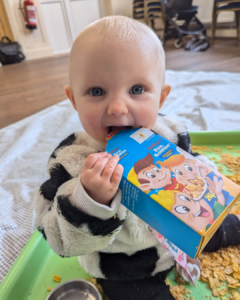
Make the game easier before making it more exciting
A new activity can quickly acquire extras.
You add more toys, introduce a second bowl and demonstrate again with increasing enthusiasm. Meanwhile, your baby has decided to inspect the carpet.
Try simplifying first.
Move the container closer. Offer one easy-to-hold object. Give them time to explore without another instruction arriving.
Changing the setup may help more than repeating “let go”.
If they seem tired or frustrated, finish with something they enjoy. A game doesn’t need a successful ending to have been worthwhile.
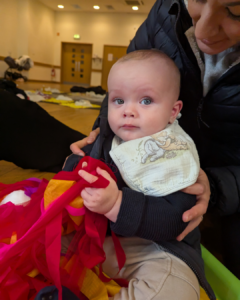
Why do they keep dropping things for you to collect?
Once dropping becomes deliberate, repetition can become the main event.
Down goes the toy. You retrieve it. Your baby watches closely, then tries again.
The American Academy of Pediatrics describes how babies explore the effects of dropping objects. Your response can become part of what makes the action interesting.
That doesn’t mean you must spend the afternoon providing an unlimited retrieval service.
Move the game to floor level, where you can both reach the toy. After a few turns, introduce another activity if you’ve had enough.
Understanding the learning can soften the irritation. Your back still deserves consideration.
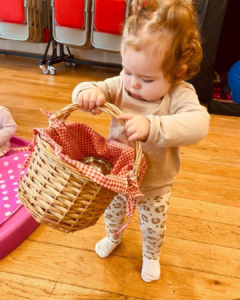
Keep small-hand play suitable for small people
Choose objects that suit your baby’s age and are too large to pose a choking risk. Check toys for damage and loose parts before playing.
Avoid coins, beads, buttons and other small household items. Your baby may explore with their mouth as enthusiastically as with their hands.
Stay close throughout the activity and use a stable container without sharp edges or places that could trap fingers.
You don’t need a collection of tiny objects to practise releasing. A few suitable baby toys offer plenty to explore.
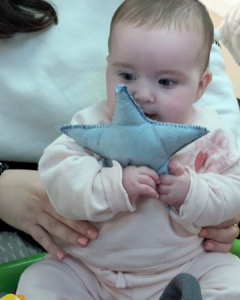
How little hand skills become part of a bigger
A story can give your baby something interesting to do with a prop.
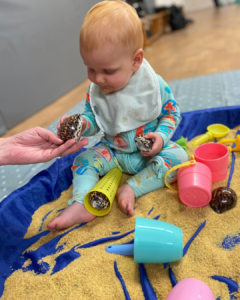
Perhaps you help a character collect suitable objects, explore a sensory tray together or enjoy taking something out and returning it.
At Adventure Babies sensory storytelling classes, books and sensory experiences offer opportunities to follow your baby’s curiosity.
Some babies watch from their parent’s lap. Others reach, hold, investigate or release.
Our class leaders help bring the story to life while you enjoy those little discoveries together. Read more about our baby sensory storytelling classes to see how shared play fits into the adventure.
There’s company for you, too. It’s reassuring to sit beside parents who understand why dropping one toy into a bowl can feel like headline news.
What if my baby finds letting go difficult?
One game cannot tell you everything about your baby’s development.
Their position, energy and interest can all change how an activity goes. A favourite toy may also be something they simply want to keep.
If you’re concerned about their hand skills, speak to your health visitor or GP. Ask for advice if you notice a strong preference for one hand during infancy, difficulty using an arm or hand, or the loss of a skill they previously had.
This NHS hand-skills guide offers further information and encourages parents to discuss concerns with a healthcare professional.
You don’t have to solve a persistent difficulty by finding more activities.
The little moment worth noticing
One day, your baby may hold a toy over a bowl, open their fingers and watch it land inside.
To anyone else, it might look like a very small event.
You’ll know how many determined attempts came before it.
Enjoy the drop, the surprised expression and the inevitable request to do it again.
Come and share more little discoveries at your nearest Adventure Babies class. Stories and sensory play for your baby, familiar faces and a warm welcome for you.