
Sensory Play at Home Without Turning the House Upside Down
Rain on the windows. Another load of washing. A baby who has examined every toy in the basket and now wants your full attention.
You search for a quick activity. Five minutes later, someone on the internet suggests dyeing spaghetti in six different colours.
Perhaps tomorrow.
Easy sensory play for babies at home can involve a book, a soft cloth and you sitting on the floor. No elaborate setup. No afternoon spent finding rice under the fridge.
For babies and toddlers aged 0–2, everyday sights, sounds and textures offer plenty to explore. Here are some rainy-day ideas that leave room for both play and a reasonably recognisable living room.

Does sensory play have to be messy?
Messy play gives children wonderful things to explore. However, sensory play also includes listening to rain, watching fabric move and feeling the difference between a smooth page and a soft toy.
Your baby doesn’t know whether you spent an hour preparing an activity. They notice what moves, what feels interesting and how you respond.
The NHS’s baby and toddler play ideas recommend using things you already have and joining in yourself. Books, songs and simple shared play all count.
That means you can keep things small. One activity on one patch of floor is a perfectly good place to start.
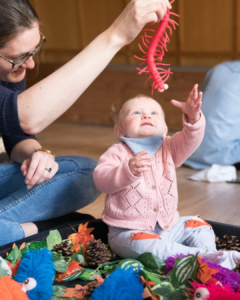
1. Turn one page into a tiny adventure
Choose a picture book and one suitable toy that connects with it. A large, baby-safe animal toy works well if an animal appears in the story.
Read a little, then pause. Make the animal’s sound. Let your baby look between the picture and the toy.
For a younger baby, your changing voice and the pictures may hold their interest. An older baby might reach for the toy. A toddler could make it stomp, hide or say hello.
Our Adventure Babies books, including Pixie Power, offer a lovely starting point for bringing stories into play.
You don’t need to finish the book. If one page inspires five minutes of exploring together, stay there.
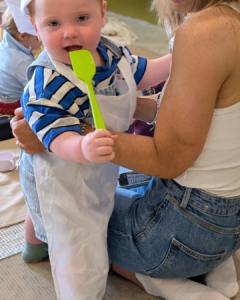
2. Make a little weather with a mini parachute
A grey afternoon outside can inspire some colourful movement indoors.
With another adult, hold a mini sensory parachute securely and make slow, gentle ripples while your baby watches from a clear space on the floor. Keep the fabric away from their face and body.
Try saying “up” as you lift it, then “down” as you lower it. Pause between movements so your baby has time to look and respond.
Older toddlers may enjoy holding an edge with your help. Add a familiar song and match the movement to its rhythm.
Follow the parachute’s instructions, supervise throughout and put it away afterwards, including its loops. There’s no need to add lots of props: the moving colours can be the whole activity.
3. Discover the soft things you already own
Find two or three clean, intact items with different textures. Try a soft flannel, a cotton cloth and an age-appropriate textured toy.
Sit together and offer one at a time. Use simple words as your baby explores: “soft”, “bumpy” or “smooth”.
Young babies can feel a cloth gently against their hand while you hold it. Babies who grasp can explore suitable items themselves. Toddlers might enjoy choosing something soft for teddy’s bed.
Check everything for loose threads and small parts, and keep fabric away from faces. Stay beside your child, especially if everything currently goes straight into their mouth.
Easy sensory play for babies at home often starts with noticing something familiar in a new way.
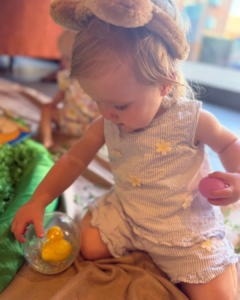
4. Let the rain provide the soundtrack
Sit safely beside a closed window and listen together.
Try copying the rain with your fingertips on the floor: a slow “tap… tap… tap”, followed by a quicker patter. Then stop.
Leave a little space for your child’s response. They might look towards the window, move their hands or make a sound.
For a toddler, ask, “Can you hear the rain?” and see what they notice. Avoid turning it into a quiz. There’s plenty to enjoy without a correct answer.
This activity needs no equipment and no clearing up. On some afternoons, that makes it particularly appealing.
5. Give one familiar toy somewhere to hide
Take a favourite baby-safe toy and partly hide it behind a book or beneath a small cloth that you hold.
Leave plenty showing at first. Ask, “Where’s your bear?” Then reveal it with a cheerful, “There!”
A younger baby may simply enjoy your face and voice. An older baby might reach towards the visible toy. Your toddler may take charge and hide it for you.
Follow their interest rather than making the game harder each time. If they want the same reveal again, you already have your next activity.
Keep cloths under your control and away from your child’s face.
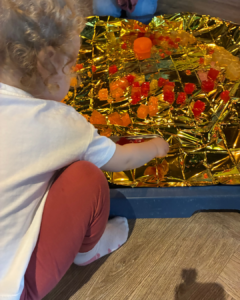
How do you keep sensory play manageable?
Start with less than you think you need. Put out one or two things and keep the rest nearby.
A small clear floor space helps contain the activity. You can add a washable mat if that makes life easier, but you don’t need a dedicated playroom.
Let your child set the pace. Looking away, becoming upset or losing interest may mean they need a change or a break. Some days, one short game will be enough.
You can stop while everyone is still enjoying it. There’s no requirement to fill the whole afternoon.
And when you fancy getting out of the house…
Home play can be lovely. So can arriving somewhere where another adult has prepared the activities.
At Adventure Babies classes, we bring books to life through sensory storytelling, props, movement and play. Your little one can explore while you share the experience and meet other parents and carers.
You may even leave with a simple idea to try at home next time the rain arrives.
Because easy sensory play for babies at home doesn’t need to take over the house. A familiar story, a little movement and a few minutes together can give a rainy afternoon somewhere new to go.