
Where Did It Go? How Babies Discover Object Permanence
Hide your face behind your hands, wait for a moment, then reappear.
To an adult, absolutely nothing remarkable has happened. To a baby, however, games like this are part of a much bigger discovery about how the world works: things can disappear from view without actually disappearing.
This developing understanding is known as object permanence, and it’s one of those pieces of baby development that sounds rather academic until you realise how often your baby is experimenting with it.
The spoon launched repeatedly from the highchair. The toy disappearing underneath the sofa. The frantic search for a book you’ve tucked behind your back. Even that gloriously repetitive game of peekaboo that you have now performed approximately 4,000 times.
Your baby isn’t simply being entertained. They’re gradually discovering that their world continues beyond what they can see.
So, when do babies understand object permanence?
The answer is much more interesting than a particular age on a milestone chart.
Object permanence isn’t an overnight discovery
You’ll often read that object permanence develops at around eight months, but modern research has made the story considerably more complicated.
Jean Piaget famously studied babies by hiding objects and watching whether they searched for them. Younger babies often didn’t, which led to the idea that if an object disappeared from sight, it effectively disappeared from their mind too.
Babies may understand more than their hands can demonstrate.
Studies using babies’ looking behaviour have found evidence that surprisingly young infants seem to expect hidden objects to continue existing. Research involving brain activity has also found evidence that six-month-old babies can maintain information about an object after it disappears from view.
Physically searching for a completely hidden object tends to emerge later, often during the second half of the first year.
That doesn’t mean the earlier understanding and later behaviour contradict each other. Instead, object permanence seems to involve several developing abilities working together.
Your baby needs to remember the object, understand something about where it has gone and, eventually, coordinate their body to do something about it.
Suddenly, finding a teddy underneath a muslin looks rather impressive.
So, when do babies understand object permanence?
Rather than thinking of object permanence as a switch that suddenly flicks on, imagine it developing in layers throughout your baby’s first year and beyond.
A younger baby may watch an object disappear and show through their gaze that they expected it to continue existing. Later, they might become fascinated when part of a toy remains visible underneath a cloth. Eventually, many babies begin deliberately removing the cloth to retrieve something completely hidden.
Even then, the story isn’t finished.
Researchers have found that babies can succeed at one type of hiding task but struggle with another that appears almost identical to an adult. Their ability to remember where an object has been hidden continues developing too.
One classic example is known as the A-not-B task. A baby repeatedly watches a toy being hidden in one place and successfully finds it. You then visibly hide the same toy somewhere else.
Some babies still reach towards the original hiding place.
They haven’t suddenly forgotten that objects exist. Their brain is juggling memory, attention and the urge to repeat an action that worked before.
Baby development is rarely as tidy as a milestone checklist makes it look.
Which explains the game every baby eventually invents…
Drop spoon.
Parent retrieves spoon.
Drop spoon.
Parent retrieves spoon.
Look parent directly in the eye.
Drop spoon again.
It can feel like your baby has discovered a surprisingly effective method of breaking an adult’s spirit, but from their perspective this is an excellent experiment.
The spoon disappears and then it comes back. Your baby does something, you do something, and the same action creates a predictable result.
They’re exploring much more than object permanence here. Cause and effect, movement, memory, communication and social interaction can all become part of this incredibly simple game.
Before automatically returning the spoon for attempt number 37, try pausing.
Does your baby look towards the floor? Perhaps they look at you, lean sideways, vocalise or point towards where it disappeared.
Those little responses can tell you far more about what they’re learning than the dropping itself.
Movement changes the game
This is one of the parts of object permanence that doesn’t get talked about enough.
Cognitive and physical development don’t happen in completely separate boxes.
Imagine knowing that your favourite toy is underneath a scarf but not yet having the balance, coordination or hand control to remove it. Understanding and demonstrating that understanding are two different things.
As babies become more confident reaching, grasping, sitting and eventually moving around, they gain completely new ways to investigate hidden things.
Now they can lift the fabric, turn around, crawl after the ball or look behind the cushion.
Research has found links between developing sitting ability, object exploration and object permanence. That makes sense when you think about how dramatically a baby’s opportunities change once their hands become free to explore the world.
The baby who once watched an object disappear can eventually go and find it.
Sometimes you can actually see the learning happening
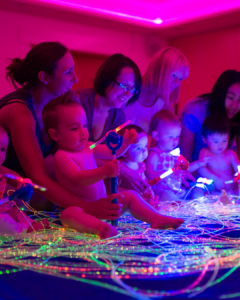
I was reminded just how much babies love this kind of play while running our Adventure Babies classes at the Natural History Museum recently.
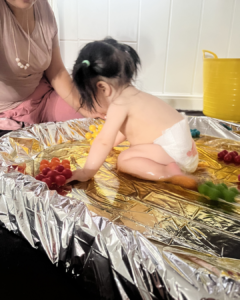
We were playing with our big silver sensory pebbles, hiding them and making them disappear before bringing them back into view. The babies were absolutely loving it.
There were huge smiles, little chuckles and that brilliant look of anticipation when they began to realise that the pebble they could no longer see might be about to come back.
It was one of those moments when something incredibly simple becomes fascinating once you look at it through a baby’s eyes.
We weren’t trying to “teach” object permanence or test whether the babies understood it. We were playing. Yet within that game, they were watching, remembering, anticipating and responding, while we reacted to their smiles and noises and repeated the bits they clearly loved.
That’s one of my favourite things about working with babies. Some of the most important learning in the first year doesn’t look like learning at all.
Sometimes it looks like a baby at the Natural History Museum chuckling because a big silver pebble has disappeared again.
This is why we hide things at Adventure Babies
If you’ve been to an Adventure Babies class, you may have noticed how often things appear, disappear and reappear during our sensory storytelling.
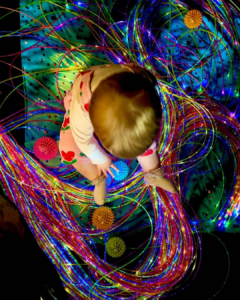
A puppet pops out of a story, something disappears beneath a scarf, a character appears from behind a prop or an object becomes partly hidden during sensory play before your baby reaches towards it.
There’s a developmental reason these simple experiences can be so interesting.
Babies learn through repeated opportunities to notice patterns, explore objects and discover what happens when they act on their environment. Our stories give those experiences a structure, while sensory materials, props, puppets and movement give babies different ways to investigate.
Most importantly, we don’t need babies to produce a particular response.
A four-month-old watching intently and a ten-month-old enthusiastically pulling away a scarf are experiencing the same activity at completely different developmental stages.
That’s exactly how it should be.
Peekaboo is cleverer than it looks
Peekaboo deserves considerably more respect.
Your face disappears and then returns, creating a wonderfully simple pattern that babies can gradually begin to anticipate.
For younger babies, the excitement may come largely from your voice, expression and sudden reappearance. As their understanding develops, they may start watching where you’ve gone, reaching for your hands or pulling the fabric away themselves.
Eventually, some babies take control of the entire game.
They hide, reappear and then wait for your reaction.
At that point, the game has become wonderfully social too. Your baby isn’t simply investigating whether something still exists when hidden; they’re sharing anticipation, humour and communication with you.
That combination of cognitive development and interaction is exactly why very simple games can offer so much.
Books can make things disappear too
This is another reason we love using books as the foundation of Adventure Babies classes.
A book is full of tiny lessons about things existing beyond the immediate moment.
Turn a page and one picture disappears while another arrives. A familiar character might appear repeatedly throughout a story, while lift-the-flap and peek-through books make hiding and finding part of the experience.
You can extend that naturally by introducing a puppet or object connected to the story.
Let your baby see the puppet, then partly hide it behind the book. Bring it back. Later, you might cover more of it and see what your baby does.
There’s no need to turn this into a test.
You’re creating an interesting experience and allowing your baby to investigate it at their own developmental level.
That difference matters enormously.
Please don’t start testing your baby
Learning about developmental stages has an unfortunate side effect. Ordinary play can suddenly become an assessment.
You hide the toy.
Your baby doesn’t look for it.
Cue the 11pm Google search: when do babies understand object permanence?
Try not to fall into that trap.
Whether a baby retrieves a hidden object depends on far more than a single cognitive ability. Their attention, memory, motivation and physical skills can all affect what happens.
Perhaps they know perfectly well that the toy is under the scarf but have spotted the label on the cushion and decided that is significantly more interesting.
Very baby.
Development also varies enormously across the first year. What matters is giving babies safe opportunities to explore rather than repeatedly checking whether they can perform a particular skill.
If you ever have genuine concerns about your baby’s overall development, speak to your health visitor or GP rather than relying on one game or milestone.
Try changing the game instead
Once you understand what your baby’s brain is beginning to work out, you start noticing opportunities everywhere.
Rather than buying an “object permanence toy”, use what you already have.
Partly tuck a favourite toy beneath a muslin and leave enough showing to attract your baby’s attention. Roll a ball slowly behind a cushion and watch where they look, or let a puppet disappear behind your shoulder before popping back into view.
You can hide your face behind a book, place an interesting object inside an open container or simply notice what happens when something falls beyond your baby’s immediate view.
Then pause.
That pause is important.
Instead of instantly showing your baby the answer, give them a moment to look, think, move or communicate.
They might surprise you.
What looks like a tiny game is actually a huge idea
This is perhaps the most fascinating part of object permanence.
Your baby begins life responding largely to a world that’s immediately available through their senses. Across the months that follow, their understanding becomes increasingly able to stretch beyond what they can see right now.
A toy can still exist beneath the blanket.
The ball can still be behind the sofa.
The puppet hasn’t vanished simply because the book is in front of it.
Eventually, your baby can hold an idea about something that isn’t currently visible and act on that information.
That’s an extraordinary cognitive step hiding inside an extremely ordinary game.
Why Adventure Babies gives babies so many opportunities to discover
At Adventure Babies, we don’t believe baby development requires constant stimulation or activities designed to push babies towards the next milestone.
We create communication-rich experiences through stories, movement and sensory play, then allow babies to explore those experiences in ways that suit their stage of development.
Object permanence is a perfect example.
Our puppets appear and disappear. Stories create anticipation. Sensory materials encourage reaching and investigation. Babies watch objects move, become hidden and return, while their grown-ups respond to the looks, noises, movements and excitement that follow.
One baby might simply stare. Another reaches towards the object, while someone else pulls away the scarf and looks delighted with themselves.
Each response tells us something about where that baby is right now.
So if you’ve been wondering when do babies understand object permanence, don’t worry too much about finding the precise week when your baby is supposed to “get it”.
Watch the smaller discoveries instead.
Notice when they follow the toy that rolled away, look towards the floor for the dropped spoon or begin pulling your hands away during peekaboo.
Their understanding of the world isn’t arriving all at once. It’s being built through thousands of tiny experiences, repeated games, shared stories and interactions with the people around them.
And if you’d like to see how we weave those opportunities naturally into stories, sensory play, movement and plenty of fun, come and discover your nearest Adventure Babies class.
Sometimes one of the biggest discoveries of your baby’s first year begins with the simplest question of all:
Where did it go?