
Your Baby’s First Autumn: Simple Sensory Adventures for Cooler Days
There’s something unexpectedly lovely about experiencing autumn with a baby for the first time.
You might have spent previous Septembers noticing that it was getting dark earlier and wondering whether it was socially acceptable to put the heating on yet. This year, there’s a tiny person experiencing crunchy leaves, cold air, enormous conkers, rustling trees and that peculiar autumn light for the very first time.
Of course, your baby has absolutely no idea that it’s autumn.
What they do notice is change.
The world sounds different when leaves crunch underneath the pushchair. Cooler air feels different against their cheeks, trees suddenly look different above them and the low autumn sun creates fascinating patches of light and shadow.
For a baby whose brain is busy learning how the world works, that makes autumn surprisingly interesting.
Why autumn is brilliant for your baby’s senses
When parents search for autumn activities for babies under one, it’s easy to end up with elaborate sensory trays that require seventeen craft supplies and considerably more preparation than any sleep-deprived parent needs.
Your baby really doesn’t require any of that.
During the first year, babies learn through ordinary experiences repeated in slightly different ways. They look, listen, reach, grab, mouth, move and gradually begin connecting what they experience with what has happened before.
Autumn changes many of those familiar experiences naturally.
A walk that looked green a few weeks ago becomes yellow, orange and brown. Trees move noisily in the wind, leaves flutter towards the ground and daylight disappears earlier. Even putting on an extra layer gives your baby different textures to feel and new movements to negotiate.
You don’t have to manufacture sensory experiences when the season is already doing such a good job.
Take the sensory play outside
One of the easiest autumn activities for babies under one is simply going for a walk and slowing down enough to let your baby experience it too.
Babies lying in a pram have a fantastic view of branches moving overhead. Once they can sit, the world suddenly appears from a completely different angle, while babies who are beginning to crawl or toddle have yet another way to investigate their surroundings.
Stop underneath a tree and watch the leaves move. Let your baby hear your feet crunch through them, then pick up a large leaf and move it slowly within their view.
You might describe what you can see, but there’s no need to narrate every second. Give your baby time to look before you say something, then watch for their response.
A widened eye, kick, reach or little noise can be their side of the conversation.
That back-and-forth is far more interesting developmentally than simply presenting one sensory object after another.
The humble leaf is actually rather exciting
To us, it’s a leaf.
To a baby, it can be something that moves when they touch it, makes a noise when they squeeze it and feels completely different from their blanket, spoon or favourite toy.
That’s cause and effect, sensory exploration and early physical development happening within one extremely ordinary object.
For younger babies, you could hold a large clean leaf where they can see it and slowly move it from one side to the other. An older baby might want to reach, grasp and investigate it themselves.
Stay close and supervise carefully, particularly because babies explore with their mouths and autumn treasures can break into small pieces.
There’s also no requirement for your baby to touch it.
Some babies launch their hands straight into every new texture, while others prefer to watch for quite a while before getting involved. Both responses give you information about your baby and how they approach something unfamiliar.
Cooler days can encourage movement too
Autumn often brings more layers, which can make moving feel slightly different for a baby who has spent summer rolling around in little more than a vest.
That makes regular opportunities for unrestricted floor play particularly useful.
Babies build the strength and coordination they eventually use for sitting, crawling and walking through everyday movement. Reaching for an interesting object, turning their head towards a sound, rolling to investigate something or stretching across their body all give them reasons to move.
Try placing an autumn-coloured scarf just within reaching distance during supervised floor play, or slowly move it through the air for a younger baby to follow with their eyes.
You’re not trying to “teach” the next milestone.
Instead, you’re giving your baby an interesting reason to use the body they’re still getting to know.

Bring autumn inside without creating a Pinterest project
Some autumn days are beautiful. Others involve horizontal rain, a screaming wind and the sudden realisation that leaving the house was wildly optimistic.
Sensory play can come indoors without requiring an afternoon of preparation.
A few autumn-coloured scarves can become a simple game of peekaboo. You might rustle tissue paper where a younger baby can hear it, move a soft scarf across their toes or let an older baby investigate a carefully supervised basket containing a few large, baby-safe seasonal objects.
Even looking through the window can become an experience.
Watch raindrops together, listen to the wind or point out a tree moving outside. Your baby may not understand your words yet, but hearing language connected to something that has captured their attention helps make communication meaningful.
The important part isn’t how impressive the activity looks.
It’s what happens between you while you explore it.
Autumn storytime hits differently too
Books are one of our favourite ways to explore seasons at Adventure Babies because stories can bring experiences together beautifully.
Choose books with woodland animals, changing weather, leaves, pumpkins or familiar outdoor scenes. Make animal noises, exaggerate the sound of the wind or pause when your baby becomes fascinated by a particular picture.
You don’t need to finish the story.
In fact, your baby may decide page three deserves eleven readings while the remaining pages are entirely irrelevant.
That’s fine.
For babies, sharing books is about much more than following a plot. They hear the rhythm of your voice, watch your expressions, begin recognising repeated sounds and enjoy a shared focus with you.
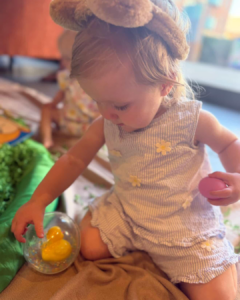
Adding a real leaf, soft scarf or woodland puppet can make the story even more tangible, which is exactly why books and sensory experiences work so naturally together in our Adventure Babies classes.
Don’t forget the dark
One of autumn’s biggest sensory changes isn’t something we can touch at all.
The light changes.
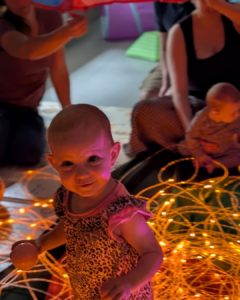
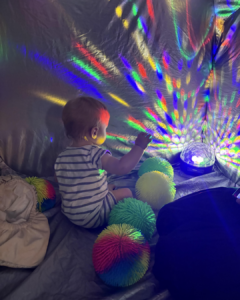
As evenings draw in, babies experience more contrast between brightness and darkness. Lamps glow differently from daylight, shadows become more noticeable and tiny lights suddenly stand out against a darker room.
You can explore that gently at home by dimming the room and watching a soft light together, noticing shadows on the wall or using a baby-safe light-up toy during supervised play.
There’s no need for flashing lights or an overwhelming sensory display.
Often the simplest visual experience gives a baby plenty to investigate.
It’s one of the reasons our darkened sensory environments at Adventure Babies can be so captivating. Against a calmer background, babies have an opportunity to focus on lights, movement and the people sharing the experience with them.
Your baby’s first autumn doesn’t need a bucket list
There can be a strange pressure attached to babies’ “firsts”.
First Christmas. First holiday. First pumpkin patch. First Halloween. First autumn photo in an adorable knitted hat that they remove approximately four seconds later.
You don’t have to turn every one of them into an event.
Your baby won’t remember whether you organised twelve autumn activities before October half-term. What they’re experiencing right now is something much more fundamental: the gradual discovery that their world is full of sounds, textures, people, patterns and change.
Let them stare at the tree.
Stop because they’ve noticed a dog.
Crunch through the leaves again because the noise made them kick their legs.
Read the same woodland book for the hundredth time because their face lights up when the owl appears.
Those tiny moments count.
Bringing autumn into Adventure Babies
Our autumn Adventure Babies classes give us endless opportunities to bring seasonal changes into our sensory storytelling.
Stories provide the starting point, then puppets, movement, music, sensory materials, lights and messy play help babies experience ideas in ways that make sense to them. Rather than expecting every baby to react in the same way, we encourage grown-ups to notice what captures their baby’s attention and respond from there.
A baby might become fascinated by a fluttering scarf, another may stare intently at the lights and someone else might ignore our carefully planned activity because another baby’s sock is apparently the most compelling object in the room.
That’s baby development.
We create the opportunities; babies show us where their curiosity takes them.
So if you’re looking for autumn activities for babies under one, you don’t need to fill every cooler day with complicated activities.
Go outside. Notice the leaves. Listen to the rain. Share an autumn story. Let your baby reach, watch, wriggle, listen and respond.
And if you’d like someone else to create the sensory adventure — and clear it all away afterwards — come and join us at Adventure Babies.
Your baby’s first autumn is already full of things they’ve never experienced before.
Sometimes all we need to do is help them notice.