
Does My Baby Get Bored? What Your Baby’s Brain Really Needs From Play
There is a particular point in the summer holidays when the days begin to feel very long.
Your usual groups may have paused, friends are away and the weather cannot decide whether it wants to deliver a heatwave or torrential rain. You have already walked around the park, read the same board book three times and offered your baby a wooden spoon with what felt like commendable enthusiasm.
Then comes the thought: does my baby get bored?
It is an understandable question. Babies cannot tell us that they have had enough of staring at the washing basket, and social media can make it seem as though every spare moment should be filled with beautifully arranged sensory activities.
The reassuring answer is that your baby does not need constant entertainment. However, babies do need opportunities to notice, explore, repeat, communicate and connect. The difference matters, because some of the most valuable experiences for a developing baby can look extraordinarily ordinary to an adult.
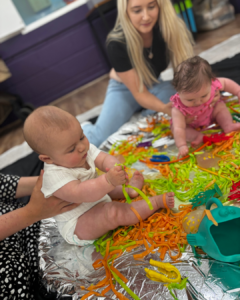
Does my baby get bored in the same way I do?
Probably not.
Adult boredom tends to come from being very familiar with something and feeling that it no longer holds our attention. Babies are experiencing the opposite. Almost everything is still new.
The ceiling fan is not simply a ceiling fan. It moves, disappears when they turn their head and reappears when they look back. A muslin has a texture, a smell and a shape that changes as it falls. Your face can smile, pause, widen its eyes and produce an astonishing number of sounds.
What feels repetitive to you is not necessarily repetitive to your baby. In fact, repetition is one of the main ways babies learn.
Each time your baby watches an object fall, hears the same phrase in a story or reaches towards a toy, their brain is gathering more information. They are beginning to recognise patterns, anticipate what might happen next and understand that their own actions can have an effect.
This is why your baby may want the same game again and again. They are not lacking imagination. They are conducting research.
Why babies need repetition more than novelty
Adults often assume that an interesting activity must involve something new. For a baby, familiarity can be just as valuable.
The first time a baby encounters a new song, texture, puppet or movement, much of their attention is devoted to taking it in. When the experience is repeated, they can begin to notice more detail. They may recognise the opening sound, move their body in anticipation or look towards the place where a favourite character usually appears.
This is the beginning of memory and prediction.
When a familiar story contains a repeated phrase, for example, a baby gradually learns the rhythm and pattern of what they are hearing. Long before they understand every word, they may become still, smile, vocalise or move in expectation of the next part.
Repeated experiences also give babies a chance to practise physical skills. A toy that was once only watched may later be swiped at, grasped, transferred between hands, shaken and eventually deliberately dropped. The object has not changed, but the baby has.
At Adventure Babies, we see this constantly. A baby who quietly observes the parachute during an early class may begin tracking it with their eyes, reaching for its strands or kicking excitedly as soon as it appears a few weeks later. There is no single correct response. Watching, pausing and taking time to process are all active parts of learning.

does your baby get bored?
Your baby is not waiting to be entertained
It can help to stop thinking of baby play as something you perform for your baby and start viewing it as something you experience together.
Some of the most powerful interactions happen when an adult notices what has caught a baby’s attention and responds to it. Your baby looks at a leaf moving in the breeze. You follow their gaze and say, “It’s fluttering.” They make a sound. You pause and answer them.
Developmental researchers often describe these responsive exchanges as serve and return interactions. Your baby “serves” through a look, sound, gesture or movement, and you “return” by responding. These small back-and-forth moments support early communication, social development and developing brain connections.
You can read more about the importance of these responsive exchanges in the Center on the Developing Child’s guide to serve and return.
The valuable part is not the sophistication of the activity. It is the shared attention.
A perfectly prepared sensory tray cannot respond to your baby. You can.
How to tell when your baby wants more stimulation
Babies vary enormously in how much stimulation they enjoy and how quickly they process it.
Some babies immediately reach towards a new object, while others prefer to watch carefully before joining in. Some are delighted by movement, music and busy social environments. Others need longer pauses and a gentler introduction.
You may notice that your baby is ready for more interaction when they:
- look towards you or an interesting object
- become more alert or physically active
- smile, kick or wave their arms
- make sounds to attract your attention
- reach, turn or shift their body towards something
- lose interest in the object they have been exploring
These are invitations rather than demands for a full programme of entertainment. Sometimes changing your position, moving into another room or introducing one different object is enough.
A baby lying beneath a play gym does not necessarily need six more toys added to it. They may simply need you to sit beside them, copy a sound they have made or move one toy slowly enough for them to follow it.
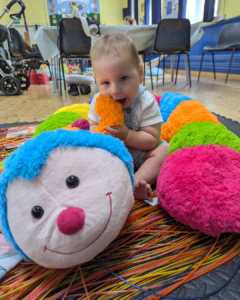
does your baby get bored?
How to tell when your baby has had enough
Knowing when to stop is just as important as knowing how to begin.
Babies can become overwhelmed when sights, sounds, movements and social interaction arrive faster than they can process them. Turning their head away is one of the clearest signals that a baby needs a pause. They may also close their eyes, arch their back, become fussy, hiccup, yawn or suddenly lose interest.
This does not mean that the activity has failed or that your baby disliked it. It may simply mean that their brain has gathered enough information for now.
Good baby play includes space to look away, rest and return.
This is one reason our sensory storytelling sessions are carefully structured rather than being a constant stream of high-energy stimulation. Stories, movement, sensory exploration and quieter moments are balanced so that babies have time to notice what is happening. Parents are always encouraged to follow their baby’s cues, whether that means joining in enthusiastically, observing from a lap or taking a break.
There is no prize for the baby who touches every object first.
Why simple objects can hold a baby’s attention
Babies are often more interested in what an object allows them to discover than what the object cost.
A scarf changes shape as it moves. A spoon makes different sounds when it taps the floor, a bowl or another spoon. A cardboard box has edges, shadows and an inside that can be filled and emptied. Water feels different on fingers, toes and palms.
Open-ended objects are interesting because they do not have one predetermined result. Babies can explore them using their senses and gradually discover new possibilities.
This does not mean placing random household objects around a baby without considering safety. Objects should be clean, too large to swallow, free from detachable parts and suitable for your baby’s developmental stage. Babies should always be closely supervised during sensory play.
The NHS baby and toddler play guidance also reminds parents that useful play can be very simple. Talking, singing, reading, reaching for objects and exploring everyday materials can all support development.
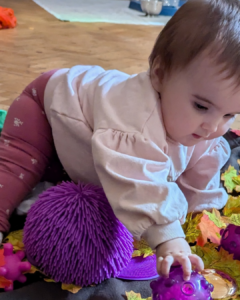
does your baby get bored?
The developmental power of a familiar story
Books are particularly effective when you are wondering how to entertain your baby because they bring several types of development together.
Your baby hears the patterns of spoken language, studies facial expressions, follows pictures and experiences physical closeness with you. As the same book is shared again, its sounds and images become familiar. Your baby may begin to anticipate a repeated phrase, reach for a page or react to a favourite picture.
BookTrust explains that sharing books from babyhood supports communication and language while also creating calm, connection and opportunities for sustained attention. You can explore more of the evidence in its article on the science behind reading with babies.
You do not need to read every word exactly as it is printed. Pause when your baby looks closely at a picture. Name what they are noticing. Add a sound, change your voice or let them safely touch and explore the book.
Reading with a baby is not a performance that must reach the final page. It is a conversation in which your baby participates through their eyes, hands, body and sounds.
This is at the heart of sensory storytelling. In our classes, stories become shared experiences through puppets, textures, movement, light, sound and carefully selected sensory materials. The aim is not to overwhelm babies with entertainment. It is to give them different ways to enter the story and communicate their interest.
Our own Adventure Babies books and sensory storytelling resources have been designed with this kind of shared exploration in mind, so families can continue the experience at home without needing to recreate an entire class in the living room.
Baby play ideas for long summer days
When your normal routine changes during July and August, it is easy to feel responsible for filling every empty hour. You do not need a new activity for every day of the holidays.
Instead, take one simple idea and allow your baby to experience it in different ways.
You might sit beneath a tree and watch the leaves moving above you. Talk about the light, movement and sounds. Let your baby feel a leaf that you are holding safely, rather than handing them something that could go straight into their mouth.
At home, place a lightweight scarf on the floor and move it slowly from side to side. Allow your baby time to watch before bringing it closer. Notice whether they track it with their eyes, move their head, kick, reach or simply become still.
You could share a familiar story outside, where birdsong, breeze and changing light add a new sensory layer. Or place a favourite toy slightly to one side during supervised floor play to encourage your baby to turn, reach or shift their weight.
Even a slow tour of the garden or house can become rich language play. Name what your baby is looking at without feeling that you need to produce a continuous commentary. Say something, pause and give them time to respond.
The NHS Baby Moves guidance offers more everyday ideas for combining interaction with physical development, including short, manageable periods of tummy time.
The key is not to rush through as many activities as possible. Stay with an experience while your baby is interested, and let it end when they have had enough.
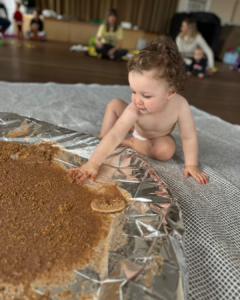
does your baby get bored?
What if my baby loses interest quickly?
A young baby’s attention is naturally brief and flexible. Looking away after a minute does not mean that they are bored, that the activity was not educational or that you need to work harder.
Their attention may have been captured by another sound. They may be tired, hungry or ready to move. They may simply have finished studying that particular thing.
Development does not depend on keeping a baby focused for an adult-approved length of time. It happens through many small experiences, repeated across days and weeks.
Your baby may engage deeply for thirty seconds and then return to the same object later. That still counts.
In fact, following their shifting attention can create more meaningful learning than repeatedly directing them back to the activity you had planned.
Do baby classes offer something different from play at home?
Babies can learn beautifully through ordinary life at home. Classes are not necessary because parents are incapable of providing developmental experiences themselves.
What a thoughtful baby class can offer is variety, structure and a shared space in which both babies and parents can explore.
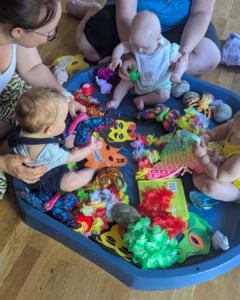
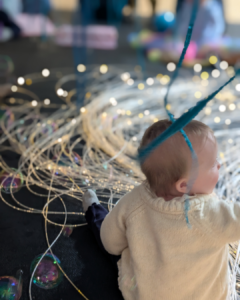
At Adventure Babies sensory storytelling classes, babies encounter stories, characters, textures, movement, music, messy play and visual experiences that have been carefully planned around early development. They also have the valuable experience of watching other babies and adults, hearing different voices and gradually becoming familiar with a group environment.
For parents, there is something equally important: being in a room where nobody expects your baby to behave in a particular way.
Your baby can watch for most of the session. They can feed, wriggle, crawl away, return, become fascinated by another parent’s sock or sleep through the finale. You are still part of it.
Many of the parents in our Adventure Babies community arrive wondering whether their baby will join in “properly”. Very quickly, they discover that there is no proper performance required. Babies participate in their own ways, and those ways change as they grow.
Classes can also lift some of the pressure from parents. Someone else has prepared the experience, thought about the developmental opportunities and will clear away the messy play afterwards. You can concentrate on your baby, meet other parents and collect ideas that are realistic enough to use again at home.
That combination of expertise and community has always mattered to us. We want parents to understand more about what their babies are learning, but never to leave feeling as though they should be doing more.
Your baby needs connection, not constant content
So, does your baby get bored?
They may lose interest, seek a change or invite you into a new interaction. However, they do not need a timetable filled with elaborate activities, and you are not failing them when the day contains quiet stretches.
Babies need time to observe. They need repetition. They need opportunities to move, touch, listen and explore. Most importantly, they need responsive people who notice what they are interested in and share the experience with them.
The most developmentally valuable thing you offer your baby is not an endless supply of entertainment.
It is you.
Your familiar voice. Your face appearing again. The pause that gives them time to answer. The story you have both heard twenty times. The delight you show when they discover something that adults stopped noticing years ago.
And when you would both enjoy a change of scenery, a beautifully prepared adventure and a room full of people who understand the strange length of a day with a baby, your local Adventure Babies class will be ready to welcome you.
does your baby get bored?