Does My Baby Need Entertaining All Day? Why Doing Less Might Be One of the Best Things for Your Baby
There is a moment that almost every new parent experiences, although very few of us admit it out loud.
It’s usually sometime around three o’clock in the afternoon. The morning has disappeared in a blur of feeding, changing nappies, settling tiny naps that somehow lasted just long enough for you to make a cup of tea but not long enough to drink it, and perhaps a quick walk around the block to stop everyone, including yourself, climbing the walls. Your baby is finally content, lying on a play mat watching the light move across the ceiling while you sit beside them wondering whether you should be doing… more.
More tummy time.
More sensory play.
More singing.
More activities.
More educational toys.
More.
You reach for your phone, intending to check the weather, and within minutes you’re watching another parent making edible finger paint from Greek yoghurt or creating an elaborate sensory tray filled with dried flowers, coloured pasta and wooden treasures. Another baby is at music class. Someone else has been to swimming. A third is proudly sharing the day’s “learning invitations” spread across the living room floor.
Suddenly your perfectly ordinary day doesn’t feel quite enough anymore.
It isn’t simply social media’s fault, although it certainly doesn’t help. Modern parenting has quietly become a project. Somewhere between the explosion of parenting advice, milestone trackers, developmental checklists and beautifully curated Instagram feeds, many of us have absorbed the idea that good parenting means constantly providing opportunities for learning. We begin to believe that our baby’s future depends on how creatively we fill every waking hour.
It’s exhausting.
More importantly, it isn’t how babies actually learn.
The pressure to optimise childhood has never been greater
One of the most fascinating shifts over the past twenty years is how much we now know about early brain development. Advances in neuroscience have transformed our understanding of the first years of life, revealing that a baby’s brain develops at an astonishing rate and that early experiences genuinely matter. That’s wonderful news, but somewhere along the way, many parents have unintentionally translated that message into something much heavier.
If early experiences matter, surely every experience needs to be educational.
If brain development is happening so quickly, perhaps every spare minute should be used wisely.
If other babies are attending classes, exploring messy play or trying a new activity every day, perhaps mine should be too.
The irony is that the science tells a very different story.
Researchers at the Harvard Center on the Developing Child have spent years studying how babies’ brains develop, and one message appears again and again throughout their work. Healthy brain development isn’t built through endless activities or expensive equipment. It grows through what they call serve and return interactions – the simple back-and-forth exchanges between a baby and a caring adult. A smile answered with another smile. A babble met with conversation. A shared look. A cuddle after a fright. These ordinary moments, repeated hundreds of times every day, help build the neural architecture that supports language, emotional wellbeing, memory and learning throughout childhood.
It’s wonderfully reassuring because most of these interactions happen without us even noticing.
While you’re fastening your baby’s coat, they’re studying your face.
While you’re chatting to the cashier in the supermarket, they’re listening to the rhythm of conversation.
While you’re folding washing together, they’re watching how your hands move and feeling the different textures of tiny sleepsuits.
Life itself becomes the classroom.
Babies don’t experience the world in separate subjects
Adults have a habit of organising learning into neat little boxes. We read books to support language, we practise tummy time to strengthen muscles, we offer sensory play to encourage exploration and we head outside for fresh air and gross motor development. Although those categories make sense to us, babies have absolutely no idea they exist.
For them, everything is happening at once.
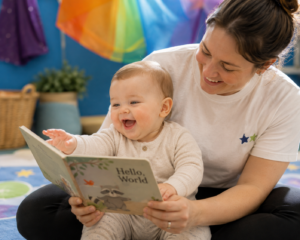
Take something as simple as reading a favourite board book together. It might look like a language activity, but your baby is doing far more than listening to words. They’re watching the tiny changes in your facial expression as you read. They’re beginning to recognise the rhythm and melody of your voice. They’re feeling the smooth pages beneath their fingertips, practising turning them, studying the colours and noticing what happens when the story always ends in the same place. At the same time, they’re strengthening the emotional connection between books and comfort because stories are becoming associated with being close to someone they love.
That single experience is supporting communication, sensory processing, fine motor skills, memory, emotional security and attention all at once.
It’s one of the reasons we are so passionate about stories at Adventure Babies. Reading with babies has never simply been about books. Stories provide an incredibly rich opportunity for babies to experience language, movement, music, sensory exploration and connection simultaneously. If you’ve ever joined one of our classes, you’ll know that a story quickly becomes an adventure, with textures to explore, props to discover, songs to join in with and plenty of opportunities for babies to investigate the world using all of their senses. The book is simply the beginning.
Research from BookTrust has consistently shown that sharing books from birth supports communication and language development while strengthening the relationship between parent and baby. Those cosy moments with a familiar story are doing far more than helping your child recognise words in years to come. They’re building positive associations with reading long before your baby understands the plot.
If you’d like to explore this in more depth, you might enjoy our article on How Do Babies Learn?, where we look at why seemingly ordinary experiences often become the most powerful learning opportunities of all.
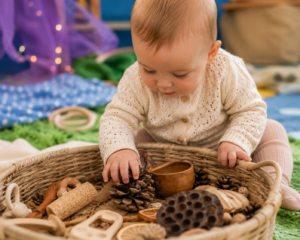
Why ordinary days are extraordinary for babies
One of my favourite moments in class isn’t when every baby is completely focused on the story. In fact, it’s often the opposite.
Every week there’s usually one baby who becomes utterly captivated by something nobody else has noticed. Perhaps it’s the ribbon gently moving above their head. Maybe it’s another baby’s delighted squeal from across the room. Sometimes it’s simply the way light catches the bubbles floating through the air.
Parents often apologise.
“I’m so sorry,” they’ll whisper. “They’re completely distracted today.”
The truth is, I never see distraction.
I see curiosity.
Babies arrive in the world with an extraordinary desire to understand it. Long before they can ask questions, they’re constantly investigating. Every sound, texture, smell, face and movement provides new information because almost everything is a first. Adults stop noticing how fascinating the everyday world really is because we’ve seen it thousands of times before. Babies haven’t.
The washing machine isn’t boring when you’ve only existed for six months. Neither is rain running down the window, the family dog wagging its tail, leaves moving in the breeze or the strange noise the toaster makes just before breakfast pops up. These moments don’t look educational from the outside, but they are exactly how babies begin building an understanding of cause and effect, attention, prediction and memory.
Perhaps that’s one of the most comforting things new parents can hear.
You don’t have to manufacture wonder.
Your baby has already found it.
Why Your Baby Doesn’t Need Constant Entertainment
If you’ve spent any time around new parents, you’ll have heard the phrase “I just don’t want them to be bored.” It slips into conversation almost without thinking. We worry if we’ve stayed at home for two days in a row. We feel guilty if the sensory toys stay in the cupboard or if the only outing we’ve managed is a walk to buy milk. Somewhere along the way, boredom has become something to avoid at all costs.
It’s an understandable fear. We all want our children to have rich, stimulating childhoods. We know their brains are developing rapidly, and naturally we want to give them every possible advantage. But perhaps the biggest surprise is that babies don’t experience boredom in quite the same way adults do.
Your baby doesn’t see an ordinary world
One of the most fascinating things about infancy is that everything is new.
That may sound obvious, but it’s easy to forget when you’re living through the repetitive rhythm of life with a baby. By the time you’ve sung Twinkle Twinkle for the seventh time before lunch or walked the same route around the park every day for a week, it feels painfully familiar to you. Your baby, however, isn’t comparing today’s walk to yesterday’s. They are still noticing things you’ve long since stopped seeing.
The changing shadows beneath a tree.
The texture of gravel beneath the buggy wheels.
A pigeon hopping across the pavement.
The sound of wind catching the leaves overhead.
Even something as simple as watching steam rise from your morning coffee is full of movement, contrast and unpredictability. These are exactly the kinds of experiences that babies are wired to notice because their brains are constantly looking for patterns.
Developmental psychologists often describe babies as “little scientists”, and it’s a description that feels remarkably accurate when you watch them closely. They aren’t passively waiting for adults to teach them. They are actively collecting information, making predictions and testing their understanding of the world. Unlike adults, they haven’t reached the stage where familiar things fade into the background.
To your baby, almost everything is still worth investigating.
Why repetition is one of the greatest teachers
If there is one thing that surprises parents in our classes, it’s how much babies enjoy repetition.
Adults tend to assume that learning comes from constantly introducing something new. New books. New toys. New songs. New experiences.
Babies often prefer exactly the opposite.
If you’ve ever wondered why your little one chooses the same board book every evening or laughs at the same puppet appearing from behind a scarf week after week, it’s because repetition is one of the ways the brain learns most effectively.
The first time your baby hears a story, they’re simply absorbing it. The second or third time, they begin to recognise familiar sounds and rhythms. A few weeks later, they’re anticipating what happens next. Long before they can speak, they start making predictions, strengthening their memory and building connections between words, actions and emotions.
It’s one of the reasons we use familiar songs, recurring characters and repeated storytelling experiences at Adventure Babies. Repetition doesn’t make experiences less valuable; it often makes them more valuable because each encounter allows babies to notice something they missed before.
If you’ve read our blog on Why Babies Love Repetition, you’ll know that this isn’t about keeping babies entertained. It’s about giving their developing brains the chance to make sense of the world through familiar experiences that gradually become more meaningful.
The same principle applies at home.
Reading the same story every night isn’t a parenting failure.
It’s one of the greatest gifts you can give your baby’s developing brain.
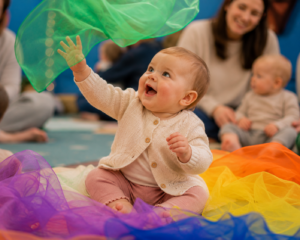
Babies don’t need constant stimulation. They need time to think.
Modern life is noisy.
Notifications buzz. Televisions play in the background. Music streams through speakers. Toys flash and sing. We often assume that more stimulation equals more learning, but neuroscience suggests something much more balanced.
Just as adults need quiet moments to process what we’ve experienced, babies also need space to absorb the enormous amount of information they’re taking in every day.
This is something we see beautifully in class.
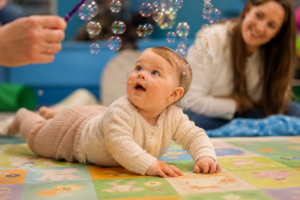
Sometimes a baby spends several minutes simply watching bubbles drift through the room. Another may quietly observe the older babies before deciding to join in. Occasionally a little one sits contentedly in their parent’s lap, taking everything in without appearing to do very much at all.
Those moments can worry parents.
“They’re not really joining in today.”
But learning isn’t always visible.
Observation is learning.
Listening is learning.
Watching another baby explore a sensory tray is learning.
One of the reasons babies often seem fascinated by other children is because they’re gathering information about faces, movement, emotions and communication. We’ve explored this in our blog Why Does My Baby Stare at Other Babies?, where we explain how those quiet moments of observation help lay the foundations for social development.
Sometimes the richest learning happens when nothing much appears to be happening at all.
The guilt that so many parents carry
Perhaps the hardest part of modern parenting isn’t the sleepless nights or the endless washing.
It’s the feeling that you’re never quite doing enough.
Many of the parents who come to Adventure Babies are thoughtful, engaged people who care deeply about giving their child the very best start. Ironically, they’re often the ones who worry the most.
They tell us they feel guilty when they stay at home.
Guilty when they put the television on for ten minutes so they can eat lunch.
Guilty when they haven’t managed a messy play activity that week.
Guilty because another baby on social media seems to be rolling sooner, babbling more or attending five different classes.
The truth is, guilt has become such a familiar part of early parenthood that many people assume it’s simply unavoidable.
It shouldn’t be.
Your baby isn’t measuring your success by how many activities you organise.
They aren’t comparing your sensory tray to someone else’s.
They’re not counting how many classes you’ve booked this month.
What they notice is much simpler.
Did someone smile when they smiled?
Did someone respond when they babbled?
Did someone comfort them when they cried?
Did someone share their excitement when they discovered something new?
These moments might seem small, but research consistently shows that responsive relationships are among the strongest predictors of healthy early development.
That doesn’t mean activities and classes aren’t valuable—they absolutely are—but their value comes from the relationships they nurture, not from ticking another developmental box.
Where Adventure Babies fits into the picture
This is one of the reasons we’ve always been careful about how we talk about our classes.
We never want parents to leave feeling that they need us in order for their baby to thrive.
Your baby learns every single day, whether you’re at home, walking through the park or reading a story together on the sofa.
What Adventure Babies offers is something slightly different.
We bring together everything we know about early childhood development—sensory exploration, language, movement, music, storytelling and responsive interaction—and wrap it into an experience that’s joyful for babies and reassuring for parents.
For your baby, it’s another rich opportunity to explore, discover and connect.
For you, it’s often something just as important.
A chance to spend time with people who understand this extraordinary stage of life.
A reminder that you’re doing better than you think.
A place where nobody minds if your baby cries, needs feeding halfway through the story or falls asleep just before the sensory play begins.
Because that’s real life with a baby.
And that’s exactly who Adventure Babies has always been for.
The greatest gift you can give your baby isn’t another activity
There comes a point in almost every parent’s journey when they realise they simply can’t do it all.
The sensory play ideas saved on Instagram haven’t happened. The stack of baby books on the coffee table still hasn’t been read. The beautiful wooden toy you were convinced would transform playtime is sitting untouched because your baby would much rather investigate the label on the changing mat or spend twenty minutes trying to catch your dog’s wagging tail.
It’s tempting to see those moments as missed opportunities.
In reality, they are often exactly what your baby needs.
One of the biggest misconceptions about early childhood development is that learning depends on us creating it. In truth, babies are remarkably good at finding opportunities to learn for themselves. Their curiosity is incredibly efficient. Given the time and freedom to explore safely, they’ll notice details that adults overlook, repeat actions until they understand them and practise new skills long before anyone thinks about teaching them.
The role of a parent isn’t to become an activities coordinator.
It’s to become a secure base from which learning can happen.
Developmental psychologists have long understood that babies learn best when they feel emotionally safe. When your baby knows you’ll respond to their cries, celebrate their discoveries and comfort them when they’re overwhelmed, they’re more confident to explore. That sense of security becomes the foundation for curiosity, resilience and independence later in childhood.
It’s a comforting thought because it reminds us that the most valuable things we give our babies are often the ones that don’t appear on any checklist.
Your attention.
Your voice.
Your smile.
Your patience when they want to read Dear Zoo for the sixteenth time.
Your willingness to stop and watch an aeroplane fly overhead simply because they’ve become completely captivated by it.
Those moments may not look productive.
But they’re quietly shaping the architecture of your baby’s developing brain.
Connection is more powerful than perfection
If there’s one thing we’ve learnt after welcoming thousands of families into Adventure Babies classes over the years, it’s that the parents who worry they’re not doing enough are almost always the parents who are doing an incredible job.
They’re paying attention.
They’re asking questions.
They’re trying.
Sometimes they simply need someone to tell them that they can stop trying quite so hard.
Modern parenting often feels like a constant search for the next thing that will benefit our children. We look for the best toys, the best routines, the best classes and the best activities because we want to give them every opportunity. While those things can absolutely enrich a baby’s experiences, they aren’t what determines whether a child feels loved, secure or ready to learn.
Research consistently shows that responsive, loving relationships have the greatest influence on healthy early development. According to the Harvard Center on the Developing Child, those everyday “serve and return” interactions between babies and caring adults form the foundation for learning, behaviour and health throughout life. Whether you’re responding to a smile, answering a babble or simply sharing a moment of eye contact, you’re helping to build your baby’s brain in ways that no toy ever could.
That doesn’t mean you have to stay at home all day.
Nor does it mean classes aren’t worthwhile.
Quite the opposite.
Why baby classes can be so valuable
The best baby classes don’t replace everyday parenting.
They enrich it.
At Adventure Babies, we’ve never believed that babies need to be entertained for forty-five minutes. What we’ve always believed is that babies thrive when they’re given rich opportunities to explore stories, language, music, movement and sensory experiences alongside the person they feel safest with.
Every activity in class has a purpose, but it never feels like a lesson.
When babies reach for floating scarves, they’re developing visual tracking and shoulder strength.
When they explore different textures, they’re learning about the world through touch while laying foundations for fine motor development.
When they hear the same story repeated over several weeks, they’re strengthening memory, recognising patterns and beginning to anticipate what comes next.
Perhaps even more importantly, parents leave with ideas they can recreate at home using everyday objects rather than feeling they need expensive equipment or endless activities.
Just as valuable is something that isn’t always talked about enough.
The community.
The early months with a baby can be wonderfully joyful, but they can also feel surprisingly lonely. Many parents spend hours talking to someone who can’t yet answer back. Adult conversation becomes precious, and meeting other people who understand why you’ve arrived wearing muslin cloths as an accessory or why you’re celebrating a twenty-minute nap can make an enormous difference.
That sense of belonging has always been at the heart of Adventure Babies. The stories, sensory play and developmental activities bring families through the door, but it’s often the friendships that keep them coming back.
If you’re wondering whether joining a class is right for your family, you can find your nearest Adventure Babies class and discover what makes our sensory storytelling sessions so different.
You’re probably already doing more than you think
If I could leave every new parent with just one message, it would be this.
Please don’t underestimate the ordinary moments.
The conversation you have while changing a nappy.
The cuddle before bedtime.
The walk where you stop because your baby is fascinated by leaves moving in the breeze.
The book you’ve read so many times you know every word by heart.
The songs you sing even though you can’t hold a tune.
The smile you instinctively give when your baby catches your eye.
None of these moments feel extraordinary while you’re living them.
Yet together they become your baby’s childhood.
They become the memories, relationships and experiences that shape how your baby understands the world and their place within it.
So, does your baby need entertaining all day?
No.
They need opportunities to explore.
They need time to wonder.
They need stories, songs and conversations.
They need chances to move, to observe and to repeat experiences until they make sense of them.
Most of all, they need people who delight in them.
The wonderful news is that you don’t have to create a perfect childhood to give your baby the very best start.
You simply need to keep showing up, day after day, sharing life together.
Some days that might look like a sensory storytelling class full of books, bubbles and adventure.
Other days it might simply be watching the washing machine together while you finally finish that cup of tea.
Both days matter.
Both days are filled with learning.
And both are more than enough.