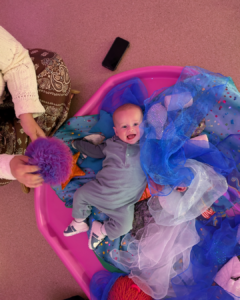
Why Does My Baby Stare at Me All the Time?
There’s a very specific kind of intense eye contact that only babies can do.
The kind where you’re just trying to eat toast or answer a message and suddenly realise somebody is studying your face like you’re the final scene in a detective documentary.
New parents often laugh about it at Adventure Babies
classes. The way babies stare while you sing. The way they watch your mouth move during stories. The way they seem utterly fascinated by you doing deeply unimpressive tasks like folding washing or drinking water.
And honestly? There’s something strangely emotional about it.
Because while adults spend a lot of time worrying whether they’re doing enough for their baby’s development, babies are often sitting there thinking:
“You are literally the most interesting thing I have ever seen.”
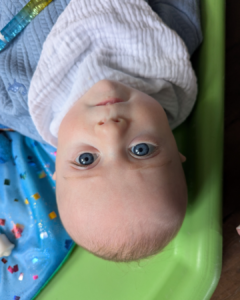
Your Baby Is Not Just Looking at You. They’re Learning You.
One of the most beautiful things about babies is that they learn people before they learn anything else.
Before toys.
Before colours.
Before language.
They learn faces.
Your baby studies your expressions constantly because human faces are one of the richest sources of information their brain can access. Every smile, eyebrow raise, mouth movement and change in tone is helping your baby build understanding about communication, safety and emotional connection.
Which means while you’re worrying about whether you’ve planned enough sensory activities today, your baby is completely captivated by watching you explain where the spoons go.
At Adventure Babies, we often reassure parents that babies do not need constant entertainment to learn well. Some of the most powerful developmental moments happen during ordinary shared interactions — eye contact during stories, smiling during songs, watching familiar people speak and move.
Babies are essentially tiny social scientists.
And you are their favourite research project.
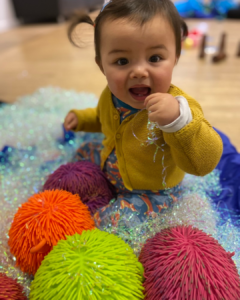
Why Familiar Faces Feel So Important to Babies
There’s actually a really fascinating developmental reason babies become obsessed with familiar faces.
When babies repeatedly see the same people responding warmly and predictably, their brains begin building emotional security. They learn:
this person comforts me,
this person responds to me,
this person feels safe.
According to Harvard University’s Center on the Developing Child
, these early responsive interactions are fundamental for healthy brain development and emotional regulation.
Which is why babies can spend huge amounts of time simply watching parents exist.
Not because you’re particularly entertaining at 7am while searching for wipes with one sock on.
But because your baby is building attachment through repeated connection.
And honestly, there’s something really lovely about that.
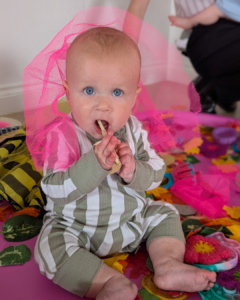
The Weird Reason Babies Watch Your Mouth So Closely
Have you ever noticed your baby staring intensely at your mouth when you talk?
It can feel slightly unnerving. Like you’re being assessed by a very small, very judgmental manager.
But this is actually one of the earliest foundations of communication development.
Babies study mouth movements long before they understand words. They watch how sounds are formed, how expressions change and how communication looks socially. Some researchers even believe babies begin mapping speech patterns visually before they can replicate them themselves.
Which means narrating ordinary life to your baby genuinely matters.
Even if the narration is:
“Mummy is reheating the same cup of tea for the fourth time.”
At Adventure Babies classes, this is one of the reasons storytelling is such a huge part of what we do. Babies learn language best through emotionally engaging experiences — hearing rhythm, repetition, expression and familiar voices paired with sensory exploration and connection.
To adults it can look simple.
To babies it’s incredibly rich learning.
Your Baby Thinks Watching You Is Premium Entertainment
Modern parenting has somehow convinced parents they should constantly perform developmental excellence.
Flashcards.
Activities.
Sensory trays made with seventeen organic ingredients you definitely forgot to buy.
Meanwhile your baby is fully emotionally invested in watching you unload the dishwasher.
Honestly, babies are deeply weird in the most reassuring way possible.
Because babies do not learn through perfection.
They learn through observation.
Watching you move around the house teaches babies about:
- routines
- facial expressions
- emotional tone
- movement
- communication
- relationships
- cause and effect
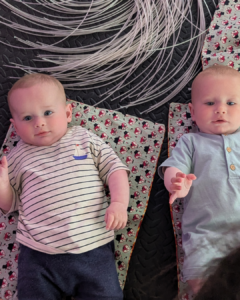
At Adventure Babies we see this all the time in classes. Babies are often just as fascinated by watching another baby laugh or a parent sing as they are by the sensory equipment itself.
Human connection is the thing they are most wired to notice.
And that’s why sensory storytelling works so beautifully for babies. It combines sensory experiences, movement, stories and emotional connection together in a way that feels natural and joyful rather than pressured.
The Science Behind “Copying” Starts Earlier Than People Think
One of the strangest things about babies is how early they begin trying to copy the people around them.
Tiny facial expressions.
Tongue movements.
Sounds.
Smiles.
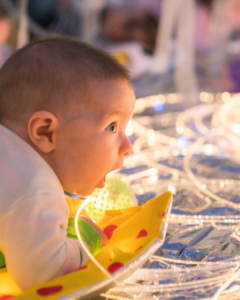
This links to something often called “mirror neurons,” which are involved in learning through observation and imitation. Babies are constantly studying how people behave and slowly beginning to connect actions with emotions and responses.
Which is why babies often light up when adults smile back at them.
Their brains are literally wiring social understanding in real time.
Honestly, when you watch babies closely enough, it becomes obvious how deeply human connection shapes development from the very beginning.
You Are Your Baby’s Favourite Place
There’s a lot of pressure on parents now to create magical childhoods.
But babies already think ordinary life with you is magical.
Your face.
Your voice.
Your reactions.
The familiar way you sing songs slightly off-key.
The stories you repeat over and over.
The way you smile when they look at you.
These are the things building your baby’s understanding of safety, love and communication.
That’s a huge part of why community and connection sit at the heart of Adventure Babies Classes
. Yes, our classes support baby development through sensory storytelling, immersive play and early communication experiences — but they also create moments where parents slow down enough to truly connect with their babies too.
And honestly? Sometimes parents need that reminder just as much as babies do.
Your Baby Doesn’t Need You to Be Perfect
A lot of new mums quietly carry guilt.
Guilt they aren’t stimulating their baby enough.
Guilt they’re tired.
Guilt they’re not doing enough activities.
Guilt ordinary days don’t look magical enough.
Meanwhile your baby is lying there staring at you like you are the most important person in existence.
Because to them, you are.
Not the perfect activity setup.
Not the expensive toy.
Not the colour-coded milestone checklist.
You.
And honestly, once you realise that, something softens a little.
Because suddenly you understand something really important:
Your baby doesn’t need you to be perfect.