
Why Your Baby Loves Being “Surprised” (But Only a Little Bit)
If you’ve ever played peekaboo and been met with pure delight—wide eyes, a pause… and then a full-body giggle—you’ve seen one of your baby’s favourite things in action:
A perfectly timed surprise.
But try the same thing in a loud, busy café, or after a long day… and suddenly that same baby might turn away, cry, or cling to you.
Same baby. Same “surprise.”
Very different reaction.
So what’s going on?
The answer sits right at the heart of your baby’s development:
their sensory threshold and their developing nervous system.
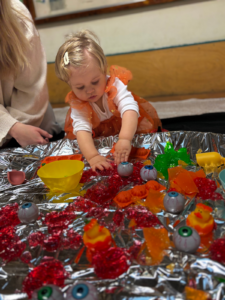
Why Babies Love Surprise (When It Feels Safe)
From a developmental point of view, surprise is incredibly powerful.
It helps babies:
-
notice changes in their environment
-
pay attention
-
begin to predict what happens next
But here’s the key—babies don’t enjoy random surprise.
They love predictable surprise.
Peekaboo is the perfect example:
-
The build-up (“Where’s mummy gone?”)
-
The pause (anticipation)
-
The reveal (surprise!)
Over time, your baby starts to recognise the pattern. They know something is coming… they just don’t know exactly when.
That tiny moment of almost knowing is where the magic happens.
It’s not just fun—it’s building:
-
memory
-
attention
-
early problem-solving
-
emotional responses
If you’ve ever noticed your baby start to smile before the reveal, that’s because their brain is beginning to predict the pattern.
The Fine Line: Stimulation vs Overwhelm
Here’s where it gets really important.
Your baby’s nervous system is still developing. They don’t yet have the ability to filter or regulate sensory input the way we do.
So while a gentle, expected surprise feels exciting…
Too much, too fast, or too unpredictable can feel overwhelming.
You might see this when your baby:
-
suddenly turns their head away
-
becomes fussy or cries
-
stiffens or startles easily
-
struggles to settle after busy environments
These are signs that their system has gone from stimulated… to overloaded.
According to the Zero to Three, babies rely on caregivers to help regulate their sensory experiences because their nervous systems are still learning how to cope with input.
In simple terms:
They can’t yet say, “this is too much.”
But their body can.
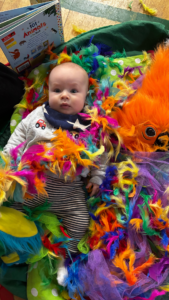
What Is a Sensory Threshold (And Why It Matters)?
Every baby has a slightly different sensory threshold—the point at which stimulation feels enjoyable vs overwhelming.
Some babies:
-
love movement, noise, and excitement
-
seek out stimulation
-
recover quickly
Others:
-
prefer calm, slower environments
-
become overwhelmed more easily
-
need longer to reset
Neither is “better” or “worse.”
They’re just different nervous systems.
Understanding this can be a huge relief for parents.
Because if your baby doesn’t enjoy loud groups, busy classes, or lots of noise… it’s not a problem to fix.
It’s something to support.
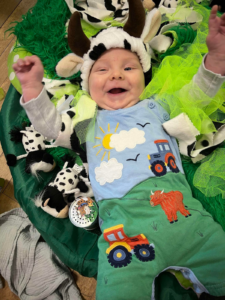
How Babies Build Tolerance to New Experiences
Here’s the reassuring part: your baby’s ability to handle stimulation does grow over time.
But not through overload.
Through gentle, repeated, supported experiences.
Think of it like building tolerance in small steps:
-
a new sound, introduced softly
-
a new texture, explored slowly
-
a new environment, with you as their safe base
Each positive experience tells your baby’s nervous system:
This is safe. I can handle this.
And gradually, their threshold expands.
Why Predictable Surprise Is So Powerful
This is where activities like songs, rhymes, and storytelling really come into their own.
They combine:
-
familiarity (the same song or structure)
-
with small moments of surprise (a pause, a sound, a reveal)
Your baby knows the shape of what’s coming…
but still gets the excitement of the unexpected moment.
This balance is what keeps them engaged without overwhelming them.
It’s stimulation—but with safety built in.
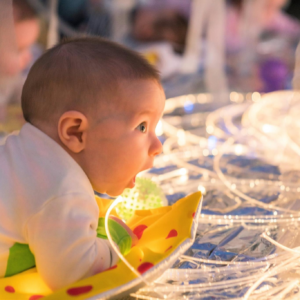
How We Use This in Adventure Babies Classes
At Adventure Babies, this balance is at the core of everything we do.
Our sensory storytelling sessions are designed to:
-
introduce gentle, predictable patterns
-
layer in small, controlled moments of surprise
-
give babies time to process and respond
For example:
-
a familiar story structure with sensory props revealed at just the right moment
-
repeated songs with slight variations
-
textures and sounds introduced gradually, not all at once
This means babies can:
-
anticipate what’s coming
-
feel safe in the structure
-
enjoy the surprise without becoming overwhelmed
Parents often tell us their babies are completely engaged—but still calm.
That’s not by accident.
It’s by design.
What This Looks Like at Home
Once you understand this balance, it changes how you play.
You don’t need louder toys or more stimulation.
You just need:
-
a familiar game
-
a small pause
-
a gentle surprise
Peekaboo.
A song with a “wait for it…” moment.
A toy revealed slowly from behind your back.
These tiny moments are doing big work.
They’re helping your baby:
-
build emotional regulation
-
feel safe with new experiences
-
learn how to handle the unexpected
Why Some Babies Love It (And Others Don’t)
If your baby doesn’t enjoy surprise in the same way as others, it can be confusing.
But it usually comes down to their sensory threshold.
Some babies:
-
crave novelty and excitement
Others:
-
prefer predictability and calm
Both are completely normal.
The goal isn’t to push your baby into enjoying more stimulation.
It’s to meet them where they are—and gently support their development from there.
FAQs: Baby Surprise Reactions & Sensory Thresholds
Why does my baby love peekaboo so much?
Because it combines predictability with surprise, helping them build anticipation, memory, and emotional responses.
What are signs my baby is overstimulated?
Turning away, crying, fussiness, or difficulty settling are all common signs.
How can I avoid overstimulating my baby?
Keep play simple, introduce new experiences gradually, and follow your baby’s cues.
Do babies need stimulation to develop?
Yes—but the right kind. Gentle, structured, and repeated experiences are far more effective than constant stimulation.
Why does my baby react differently to others?
Every baby has a different sensory threshold and nervous system. Variation is completely normal.
The Takeaway
Your baby doesn’t just love surprise.
They love safe, predictable surprise.
The kind that makes them pause…
then smile…
then laugh.
And in those small, joyful moments, they’re learning something powerful:
That the world can be exciting—
and safe at the same time 💛