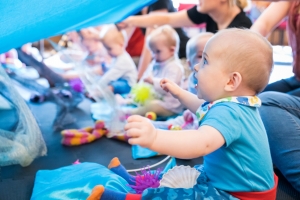
How Sensory Play Supports Baby Brain Development
Why sensory exploration matters more than you think in the first year of life
In the first year of life, your baby’s brain is growing at an astonishing rate.
By the age of one, the brain has reached around 60% of its adult size. Millions of neural connections are being formed every second — and the thing driving that growth isn’t worksheets, flashcards or screens.
It’s sensory play.
Touching. Looking. Listening. Tasting. Moving. Repeating.
Understanding how sensory play supports baby brain development can help you feel confident that the everyday moments you’re already sharing with your baby are doing far more than you realise.
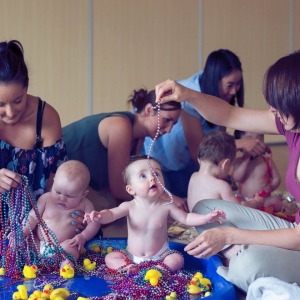
The Baby Brain: Built Through Sensory Experience
Babies aren’t born with a fully wired brain. Instead, they’re born with the potential to build one.
Every time your baby experiences something new — a sound, a texture, a smell, a movement — their brain forms connections between neurons. These connections (called synapses) are the foundation of learning, memory, attention and problem-solving.
The more meaningful and repeated the sensory experience, the stronger those neural pathways become.
This is why sensory exploration in the first year of life is so powerful.
How Sensory Play Develops Your Baby’s Brain
👀 Sight and Visual Development
From high-contrast visuals to tracking movement, visual sensory play helps babies develop focus, depth perception and early pattern recognition.
Watching bubbles float, scarves move or lights glow isn’t just entertaining — it’s helping the brain learn how to process and organise visual information.
👂 Hearing and Language Foundations
Babies’ brains are constantly tuning into sound.
Music, rhythm, voices and environmental noises support auditory processing, which later underpins speech and language development. Repeated songs, familiar voices and changes in pitch help babies recognise patterns, anticipate what comes next and respond.
These early listening skills are an essential part of cognitive development in babies.
✋ Touch and Body Awareness
Touch is one of the most powerful sensory systems in early development.
Exploring different textures — soft, rough, wet, squishy, cold — sends signals along sensory pathways to the brain. This helps babies:
- understand where their body is in space
- build coordination and control
- develop early problem-solving skills
What happens if I squeeze this? What if I let go?
👃 Smell and 👄 Taste
Often overlooked, smell and taste play an important role in emotional and cognitive development.
Familiar smells and tastes help babies feel safe, regulated and curious — creating the emotional security that allows learning to happen.
Sensory Play and Cognitive Development: What’s the Link?
Cognitive development refers to how your baby thinks, learns, remembers and understands the world.
Sensory play supports baby brain development by helping babies:
- 🧠 Understand cause and effect
When I kick, the lights move. When I shake, it makes a noise. - 🧠 Build attention and focus
Sensory-rich experiences gently encourage babies to concentrate for longer periods. - 🧠 Develop memory
Repeated sensory experiences help babies recognise what’s familiar and what’s new. - 🧠 Strengthen problem-solving skills
Babies learn through trial, error and repetition — long before they can crawl or talk.
Why Multi-Sensory Play Is So Effective for Babies
The brain doesn’t develop in isolated sections — it develops through connected systems.
When babies see, hear, touch and move at the same time, multiple areas of the brain are activated together. This creates richer, stronger neural pathways.
That’s why multi-sensory play for babies — combining music, movement, textures and visual storytelling — is especially effective in the first year.
It doesn’t overwhelm the brain.
It helps organise it.
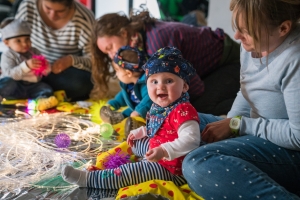
What Sensory Exploration Looks Like in Everyday Life
From the outside, sensory play might look simple:
- a baby watching scarves float
- hands splashing in water
- fingers exploring different textures
- listening to a familiar song
And no — this doesn’t require expensive toys or complicated activities.
But inside your baby’s brain?
Connections are forming. Pathways are strengthening. Foundations for future learning are being laid.
This is why sensory play for babies isn’t an optional extra — it’s essential.
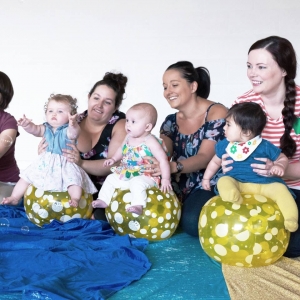
Sensory Exploration at Adventure Babies
At Adventure Babies, everything we do is rooted in how babies actually learn.
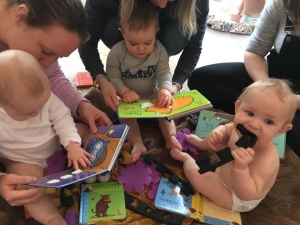
Our classes are carefully designed to support baby brain development through age-appropriate sensory play, including:
- immersive storytelling
- music and rhythm
- movement
- visual and tactile exploration
All within a calm, supportive environment that allows babies to explore at their own pace.
For parents, it’s a chance to:
- understand how your baby is learning
- feel confident supporting their development
- enjoy moments of connection and wonder
For babies, it’s joyful, meaningful brain-building — disguised as play.
The Takeaway
Your baby doesn’t need more things.
They need more experiences.
Every sensory moment — no matter how small — plays a role in shaping how your baby’s brain grows, learns and understands the world.
And when sensory play is offered thoughtfully, gently and repeatedly, it becomes one of the most powerful tools for baby brain development in the first year of life.
If you’d like to explore this together — without planning, prepping or second-guessing — Adventure Babies classes are designed to support both you and your baby, one sensory adventure at a time. 💛