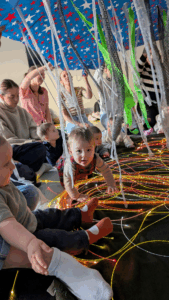
When Do Babies Start Crawling? The Funny, Wiggly, Totally Normal Truth About This Milestone
If you’ve ever found yourself Googling “when do babies start crawling?” while watching your baby face-plant into the playmat for the 40th time… welcome. You’re in the right place.
Crawling is one of those milestones that feels HUGE — partly because it unlocks a new level of independence for babies, and partly because it unlocks a new level of chaos for parents. (Why do they always crawl toward the one plug socket you forgot to baby-proof?)
But fear not. Here’s everything you actually need to know about crawling, from development to different crawling styles to how Adventure Babies classes support all those delicious gross motor skills.
So… When Do Babies Start Crawling?
Most babies start crawling between 6–10 months, but — big sigh of relief incoming — normal covers a huge range. Some babies crawl earlier, some later, some skip crawling entirely and go straight to cruising or walking like tiny overachievers.
If your baby is still stationary at 10 months, don’t panic. They’re not “behind.” They’re simply plotting.
Why Crawling Matters (Beyond Catching Them Before They Eat Fluff)
Crawling isn’t just adorable. It’s brain-building.
It develops:
-
Coordination (arms + legs + head = teamwork!)
-
Core strength
-
Balance
-
Spatial awareness
-
Cross-lateral movement — the magical brain skill that supports reading later on.
Yes, crawling helps reading. Who knew your baby scooting backwards into a wall was actually an act of academic excellence?
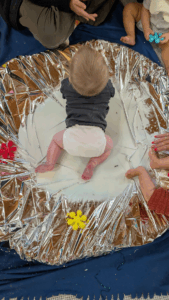
The Many… Many… Styles of Crawling
There is no “right” way to crawl. Just their way. Here are the classics:
1. The Traditional Crawl
Hands, knees, purposeful expression. The gold standard.
2. The Commando Crawl
Elbows, belly, pure determination. Think army training but squishier.
3. The Bum Shuffle
Sit down, wiggle forward, repeat. Often faster than actual crawling.
4. The Backwards Crawl
Babies who desperately want the toy in front of them but somehow keep moving further away from it. Iconic.
5. The One-Legged Scoot
Like crawling, but with flair.
6. The Launch-and-Lunge
A dramatic flopping forward movement that somehow counts as progress.
All of these are normal. All of them build strength. All of them make excellent home videos.
What Comes After Crawling?
Once babies get the hang of moving, everything snowballs. Next steps include:
-
Pulling to stand
-
Cruising along furniture
-
Standing without support
-
Walking (eventually… when they’re good and ready)
Gross motor skills are beautifully interconnected — and crawling is a big chapter in the story.
How Adventure Babies Sessions Support Crawling + Gross Motor Development
Although our classes are known for books, magic, and sensory wonder, they’re also a sneaky workout for your baby’s body.
In Adventure Babies sessions, your little one gets to:
-
Reach, supporting shoulder stability
-
Twist and stretch, great for core strength
-
Explore textures, boosting sensory processing
-
Roll, wriggle, push up and move, building all the pre-crawling skills
-
Follow story-based movement prompts, which encourage cross-lateral patterns
All while having fun. And all while you get a lovely moment to breathe, chat, and watch your baby shine.
How You Can Encourage Crawling at Home
A few easy ways to help:
-
Plenty of tummy time (start small, build up)
-
Place toys just out of reach
-
Let them explore safely on the floor
-
Play tunnels, textures and sensory play
-
Get down on their level and model movement
And if you want ready-made inspiration?
Adventure Babies sessions are packed with movement opportunities woven into storytelling magic.
The Bottom Line
If you’re wondering “when do babies start crawling?” — the short answer is: when your baby is ready.
Some wiggle, some roll, some scoot, some zoom. All are normal. All are brilliant. And all are part of your baby’s wonderfully unique journey.
And we’d absolutely love to be part of it.
✨ Find your nearest Adventure Babies class and let the wiggling begin.