How to Help My Baby Develop Fine Motor Skills: Tiny Fingers, Big Discoveries
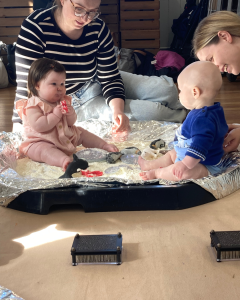
Ever watched your baby determinedly try to grab a toy, miss, and then immediately shove their whole fist in their mouth instead? Congratulations — you’ve just witnessed fine motor skills in action! Those small but mighty hand and finger movements are the building blocks for everything from feeding themselves to turning pages in a book (and later… writing, drawing, and zipping their own coat — although let’s not rush that one).
What Are Fine Motor Skills in Babies?
Fine motor skills are all about the coordination between your baby’s hands, fingers, and eyes. It starts way earlier than you might think — even that newborn reflex grip that wraps around your finger like a vice is the first step! Over time, babies learn to control those movements, going from random flails to purposeful actions like reaching, grabbing, poking, and clapping.
Every time your baby practises these tiny movements, they’re building brain connections that support independence, curiosity, and problem-solving. It’s like a gym workout for their brain and body — except the weights are colourful scarves, story props, and squishy sensory toys.
Fine Motor Skill Milestones: 0–12 Months
0 to 6 Months: Little Hands Waking Up
In those early months, your baby is discovering they have hands — and that those hands can actually do things! Here’s what fine motor development looks like from 0–6 months:
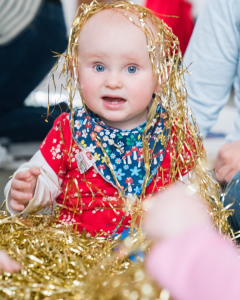
👀 Follows movement with their eyes – Dangling toys or sparkly props at Adventure Babies help babies practise tracking movement — a key part of hand-eye coordination.
🤲 Clasps and unclasps hands – That sweet moment when they bring their hands together shows growing awareness and control.
🫶 Engages in finger play – Wiggling fingers, exploring fists, and grabbing toes strengthen little hand muscles.
🎵 Holds a rattle briefly – Your baby might grab but can’t yet coordinate hand and eye movements — and that’s perfectly normal.
These tiny movements may not look like much, but they’re laying the groundwork for everything to come. Every shake, reach, and grasp is helping your baby’s brain understand how their body works.
6 to 12 Months: Hands-On Discovery
By the second half of the first year, your baby’s hands are suddenly busy. Everything is an opportunity to explore (and yes, to put straight into their mouth).
Here’s how fine motor skills develop between 6–12 months:
👁️ Moves head and eyes to follow objects – Tracking becomes smooth and intentional.
🤲 Reaches and grasps toys – First with both hands, then confidently with one.
🍼 Holds a bottle – A sign of growing independence.
🖐️ Uses a palmar grasp – Scooping toys up with their whole hand.
🔄 Passes objects between hands – Strengthens coordination and awareness.
👅 Puts objects in the mouth – Learning about texture and shape (though not your phone, please).
🎲 Drops toys repeatedly – They’re practising control and cause and effect — not just testing your patience!
🎁 Takes toys out of containers – And may even try to hand something to you.
🥄 Attempts to feed self – The early (messy) signs of independence.
🔍 Turns objects over – Curiosity and dexterity in action.
👆 Pokes with one finger – Early pointing and exploring.
🧶 Pulls toys closer using fingers – The beginnings of a “scissor grasp.”
📎 Starts using a pincer grasp – Picking things up between thumb and finger — like crumbs, fluff, or anything you’d rather they didn’t.
👏 Claps hands together – And suddenly, you’re clapping too because it’s ridiculously cute.
How Adventure Babies Helps Your Baby Develop Fine Motor Skills
At Adventure Babies, we make helping your baby’s fine motor skills easy, fun, and full of magic. Every part of our classes is designed to encourage grasping, reaching, exploring, and experimenting — all through sensory storytelling and play.
Here’s how our adventures help:
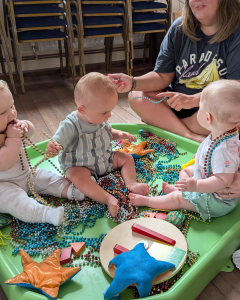
🪶 Sensory play – Squishing, scrunching, patting, and scooping build strength and coordination.
📚 Story props – Babies pick up soft toys, shake rattles, or help turn pages — supporting hand-eye coordination through storytelling.
✨ Messy play – Squeezing sponges or splashing water strengthens hand muscles (and makes brilliant memories).
🎶 Action songs – Clapping, finger wiggling, and peekaboo are secretly brilliant fine motor workouts.
These activities don’t just help your baby’s fine motor development — they also spark curiosity, build concentration, and boost confidence.
Why Fine Motor Skills Matter (Even When It Looks Like Chaos)
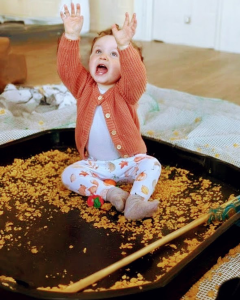
Fine motor skills are essential for everything that follows — from self-feeding to early writing. They help babies develop control, coordination, and independence. So next time your baby gleefully flings oats across the room during sensory play, remember: it’s not mess, it’s motor mastery.
Keep the Adventure Going
The best way to help your baby develop fine motor skills is to let them explore! Offer interesting textures and safe objects, join in their play, and let things get a bit sticky.
At Adventure Babies, every story, texture, and giggle helps your baby strengthen those tiny hands and curious minds.
👉 Find your nearest Adventure Babies classand discover how sensory storytelling can help your baby’s fine motor skills flourish.