
When Do Babies Start Rolling Over?
(And why it’s such a big deal!)
One minute your baby’s lying there, gazing adoringly at you with that gummy smile… the next, they’ve wriggled onto their tummy and are halfway across the play mat. Rolling over might seem like a small step in the big picture of baby milestones, but it’s actually a huge leap in your baby’s physical development — and it often comes with a big proud-parent “Did you SEE that?!” moment!
Where Rolling Fits in the Baby Milestone Timeline
Before rolling, your baby’s been busy building strength and coordination — lifting their head during tummy time, kicking their legs, waving their arms about, and figuring out that all these wobbly limbs belong to them.
Rolling is usually one of the first “big” milestones of movement — it bridges the gap between those early newborn reflexes and the more coordinated skills that come later, like sitting, crawling, and walking. Think of it as your baby’s first real taste of independence: “I can move my body to get what I want!”
If you’d like to read more about how babies build up to these skills, check out our post on how babies develop fine motor skills and and baby physical development.
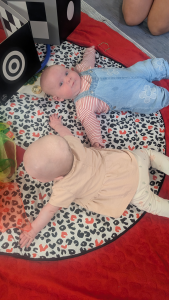
When Do Babies Start Rolling Over?
Every baby’s different (we know, we know — you’ve heard that a million times, but it’s true!).
Here’s a rough guide:
-
Around 3–4 months: Some babies start rolling from tummy to back as they strengthen their neck and shoulder muscles.
-
Around 5–6 months: Many babies manage back-to-tummy rolls — trickier, because they need to work against gravity.
-
Around 6 months and beyond: Rolling becomes part of play and exploration, and your baby may use it to move around intentionally (or to roll away just as you try to change their nappy!).
You can find more milestone guidance from the NHS baby development timeline — but remember, every baby follows their own rhythm.
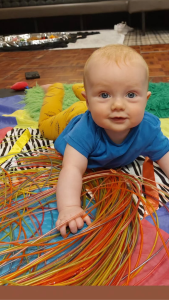
What Helps Babies Learn to Roll?
Rolling takes coordination, strength, and confidence — and playtime is your baby’s training ground!
Here are some easy ways to support rolling:
-
Tummy time, every day: Builds those core and neck muscles.
-
Encourage reaching: Place toys just out of reach so your baby practices twisting and leaning.
-
Lots of floor time: Babies need space to move freely — not too much time in seats or swings.
-
Interactive play: Get down at their level, talk, sing, and use interesting textures or sounds to grab their attention and get them wriggling.
At Adventure Babies classes, we see this moment happen all the time — that magical combination of curiosity and determination as a baby suddenly flips themselves over during storytime! Parents always gasp, clap, and share knowing looks like, “Oh no… the days of staying put are officially over.”
One mum laughed recently, “He rolled for the first time in class — I think it was the smell of the banana sensory tray that motivated him!” Another said, “I’d been waiting for weeks, and then she just did it mid-story, right as the bubble machine came out. I cried!”
These little milestones are even sweeter when shared — and our sessions give babies so many opportunities to move, reach, stretch, and explore in ways that naturally support rolling and other motor skills.
If you’d like to know how other sensory experiences support development, have a look at our post about how babies develop their senses.
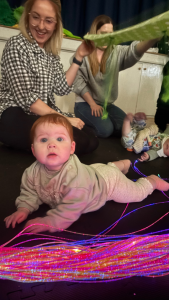
What Comes After Rolling?
Once your baby masters rolling, they’re preparing for the next adventures in movement — sitting, pivoting, crawling, pulling up, and eventually those wobbly first steps. Rolling builds core strength and balance, which are essential foundations for everything that comes next.
If your little one’s starting to move, you might find our post about how to support baby fine motor skills through play helpful — it’s full of ideas that celebrate what you’re already doing at home!
Rolling FAQs
🍼 My baby hasn’t rolled yet — should I be worried?
Not necessarily! Some babies skip rolling altogether and move straight to sitting or crawling. If your baby is alert, active, and developing other skills (like holding their head up or reaching for toys), they’re likely doing just fine. If you’re concerned, mention it to your health visitor — but remember, babies do things in their own time.
🍼 Do I need to “teach” my baby to roll?
You don’t need to teach it in a formal way — just give them time, space, and encouragement. Offer plenty of tummy time, let them explore safely, and respond when they try new movements. Your baby’s natural curiosity does the rest.
🍼 Is it normal for my baby to only roll one way?
Yes — most babies start by rolling one direction first. Over time, they’ll build the strength and coordination to roll both ways. You can help by encouraging play on both sides.
🍼 Can classes help with physical development like rolling?
Absolutely. At Adventure Babies, our sensory storytelling sessions are full of opportunities for movement — reaching for props, turning toward sounds, and exploring different textures. Babies develop strength and coordination naturally while having fun with you (and without even realising they’re working hard!).
For safe tummy time and play advice, we also love the guidance from The Lullaby Trust — perfect for supporting rolling at home.
The Bottom Line
Rolling is a joyful sign your baby’s growing stronger, braver, and ready to explore their world. It’s the start of movement — and chaos! So, celebrate the little flips and wiggles, and know that every twist and turn is a tiny step toward independence.
If you’d love to give your baby a space to explore movement, imagination, and connection, come and join us for an Adventure Babies class near you